
Your Admin Button Says “Allow.” Your Turkish User Reads “Risk.”
Enterprise users hesitate when permission language does not clearly explain authority, scope, and reversibility.
Turkish SaaS Admin Permissions Localization: Why Enterprise Users Hesitate Before Granting Access
A Turkish enterprise customer is ready to configure your SaaS product. The buyer has signed. The kickoff call went well. The admin opens the dashboard and starts assigning roles.
Then they pause.
A button says “Allow access.” A modal asks them to confirm a permission. A role description says a user can “manage account settings.” In English, this feels ordinary. In Turkish, it can feel too broad, too final, or too unclear.
That pause matters. Enterprise users do not click through uncertainty when authority, data, and account control are involved. This is where admin UI language becomes part of a controlledTurkish localization workflow, not a cosmetic interface layer.
What Actually Breaks
Admin flows are usually written by product teams that already understand the system. That creates a blind spot. The copy assumes the user knows what a permission means, what can be reversed, and where the boundary sits between user control and account risk.
When those strings are translated into Turkish without rebuilding the intent, the interface may sound technically correct but operationally unsafe. “Yönet” can be too broad. “İzin ver” can sound final. “Erişim sağla” can feel vague if the object of access is not explicit.
This is where teams need more than generic string handling. They needprofessional Turkish translation processes that preserve authority, scope, consequence, and user trust.
The user does not complain. They delay configuration, ask an internal IT colleague, open a support ticket, or avoid using the feature.
Why Turkish Changes the Permission Risk
Turkish makes responsibility more visible. A permission label has to clarify who can do what, where, and with what consequence. English often hides this inside compact UI labels. Turkish users expect more explicit boundaries, especially in enterprise software.
There is also formality. Admin interfaces cannot sound casual when access control is involved. But they also cannot sound like legal threats. The tone needs to be controlled, calm, and exact.
If the language sounds vague, the user assumes the risk belongs to them. That is when adoption slows, and that is why admin UI strings should pass structuredtranslation quality assurance before rollout.
The Business Damage You Usually Misread
The dashboard may show delayed onboarding, unused integrations, low feature adoption, or repeated questions from admins. Product teams may treat this as UX friction or customer education debt.
Often, it is language debt. The user is not unable to proceed. They are unwilling to proceed because the Turkish interface does not make the action safe enough.
In enterprise SaaS, this directly affects time-to-value. A customer that cannot confidently configure roles cannot roll out the product across teams. It becomes even more sensitive when permissions involve data access, audit trails, integrations, or confidential account information handled undersecure and confidential project expectations.
What Proper Turkish Localization Does Instead
A strong Turkish admin flow names the object, the action, and the consequence. It avoids vague permission verbs. It explains whether the action can be changed later. It keeps role terminology stable across dashboard, help center, onboarding email, and contract language.
The review should cover buttons, tooltips, empty states, confirmation modals, warning banners, audit logs, and integration permission screens. These are the places where trust either holds or breaks.
For high-risk admin flows, Turkish localization must behave like a controlled UX system. It is not enough for the label to fit the button.
What to Audit Before Turkish Enterprise Rollout
List every screen where a user grants, removes, edits, approves, shares, connects, imports, exports, or deletes something. These verbs carry risk.
Then check whether the Turkish version clearly identifies scope and reversibility. Does the user know whether the action affects one person, a team, a workspace, billing, data, or the entire account?
Finally, align terminology with your Turkish help center and enterprise onboarding materials. If the same role is named differently in three places, administrators lose confidence.
Enterprise SaaS adoption does not fail only because of missing features.
It can fail because the person responsible for configuration does not trust the words around authority.
A good Turkish admin interface makes control feel controlled. Not shorter text. Safer action.
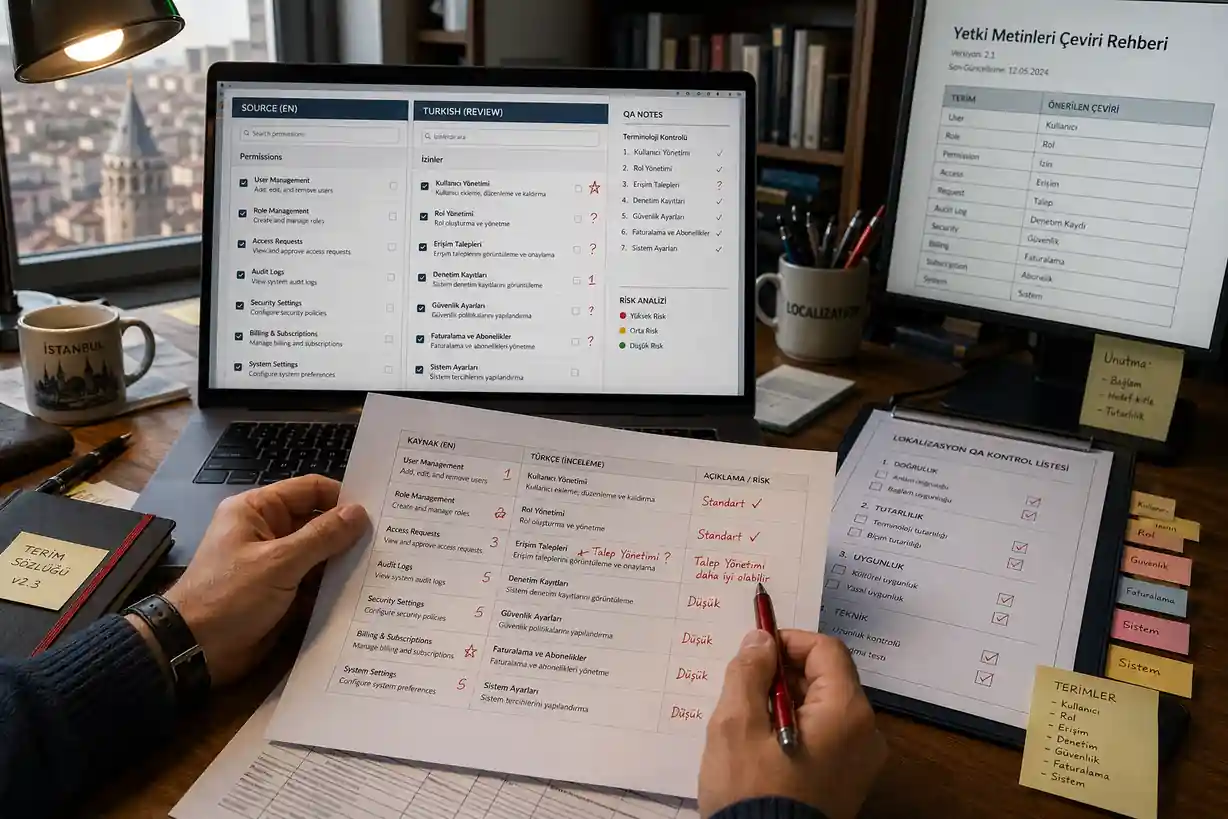
Process authority: review the message, terminology, and decision logic before the market exposes the weakness.
FAQ
Why are admin permission screens difficult to localize into Turkish?
Because Turkish users need clear boundaries around authority, scope, and reversibility. A literal label may be accurate but still fail to explain what access is being granted.
Can permission wording affect enterprise adoption?
Yes. If administrators hesitate to invite users, assign roles, connect integrations, or approve access, onboarding slows and product trust weakens.
What should be checked in Turkish admin UI localization?
Role names, warning text, action labels, confirmation messages, access descriptions, audit wording, and help text should all use one controlled terminology system.
Make Turkish Admin Flows Safe Enough to Complete
We review Turkish SaaS admin interfaces for permission clarity, trust language, role terminology, and enterprise adoption risk.
Request SaaS Admin Localization Review