
Your Global HR Policy May Be Clear. The Turkish Version May Not Feel Fair.
Internal trust breaks when policy language sounds translated, punitive, or culturally disconnected.
Review Turkish localization supportTurkish HR Policy Localization: Why Employees Misread Global Policies
A global HR policy is approved at headquarters. Legal has reviewed it. People operations has signed off. The English version is clear enough.
Then it reaches employees in Türkiye.
Suddenly the tone changes. A supportive policy sounds disciplinary. A benefits explanation feels vague. A reporting procedure sounds intimidating. A code of conduct reads like a legal warning instead of internal guidance.
Nobody intended that. But employees do not read intention. They read the Turkish words in front of them. That is why HR policy work belongs inside a controlled Turkish localization strategy, not in a last-minute translation queue.
HR Policy Translation Is an Employee Trust Moment
Internal documents are often treated as low-risk compared with contracts, regulatory submissions, or customer-facing content. That is a mistake.
HR policies tell employees how the company sees them. If the Turkish version sounds cold, confusing, or punitive, the employee experience changes.
A global company may want to communicate fairness, inclusion, clarity, and support. But a literal Turkish translation can accidentally communicate distance, control, or threat. This is where professional Turkish translation must protect both meaning and employee-facing tone.
This is not cosmetic. It affects whether employees understand the policy, believe it, and use it correctly.
Where Turkish HR Policies Go Wrong
The first problem is tone. English HR language often uses soft institutional phrasing: “we encourage,” “you may,” “please contact,” “where appropriate.” Turkish versions can become either too informal or too legalistic if handled without HR context.
The second problem is obligation language. Employees need to distinguish between a right, an option, a requirement, a recommendation, and a disciplinary rule. Turkish phrasing must make those boundaries clear.
The third problem is cultural expectation. Turkish employees may read hierarchy, fairness, and institutional seriousness differently. A reporting channel must sound safe. A performance process must sound structured. A benefits policy must sound reliable.
Why Direct Translation Creates Risk
Direct translation preserves words but often loses organizational tone. A phrase meant to reassure may sound like a warning. A simple instruction may sound like an order. A neutral condition may sound like a loophole.
This matters because employees make decisions based on these documents: whether to report a concern, whether to ask about benefits, whether to challenge a review, whether to trust a process.
If the Turkish policy is unclear, employees do not always ask HR. They talk to each other. Misinterpretation spreads faster than clarification, especially when internal policies are not reviewed under proper translation quality assurance before publication.
The Business Cost of Weak Internal Localization
Poor HR localization can create avoidable support volume, employee dissatisfaction, inconsistent manager behavior, and unnecessary legal sensitivity.
For multinational companies expanding in Türkiye, internal language is part of local credibility. Employees notice whether the company has adapted properly or merely translated headquarters language into Turkish.
This becomes especially important in onboarding, performance management, compliance training, anti-harassment policies, whistleblowing procedures, data privacy notices, and benefits communication. Those files often belong to the same risk family as corporate policies and internal manuals, where wording affects behavior, escalation, and trust.
What Proper Turkish HR Policy Localization Does
A strong workflow separates legal meaning from employee-facing readability. Some sections must remain formal. Others need plain Turkish. The reviewer must know which is which.
Terminology must be stable across HR documents. If the handbook uses one term for manager, employee, disciplinary process, leave entitlement, complaint, or reporting line, every connected document should follow that logic.
The final Turkish version should be tested for employee interpretation. Does it sound fair? Does it sound clear? Does it explain the next step? Does it preserve authority without unnecessary harshness?
HR policy language may also contain sensitive employee data, grievance details, investigation language, or reporting channels. That means the workflow must respect confidential translation protocols as well as linguistic accuracy.
Employees do not evaluate policies as translators.
They evaluate them as people affected by the policy.
If the Turkish version sounds unfair, unclear, or distant, trust drops.
A good Turkish HR policy does not simply match the English source. It makes the company understandable inside Türkiye.
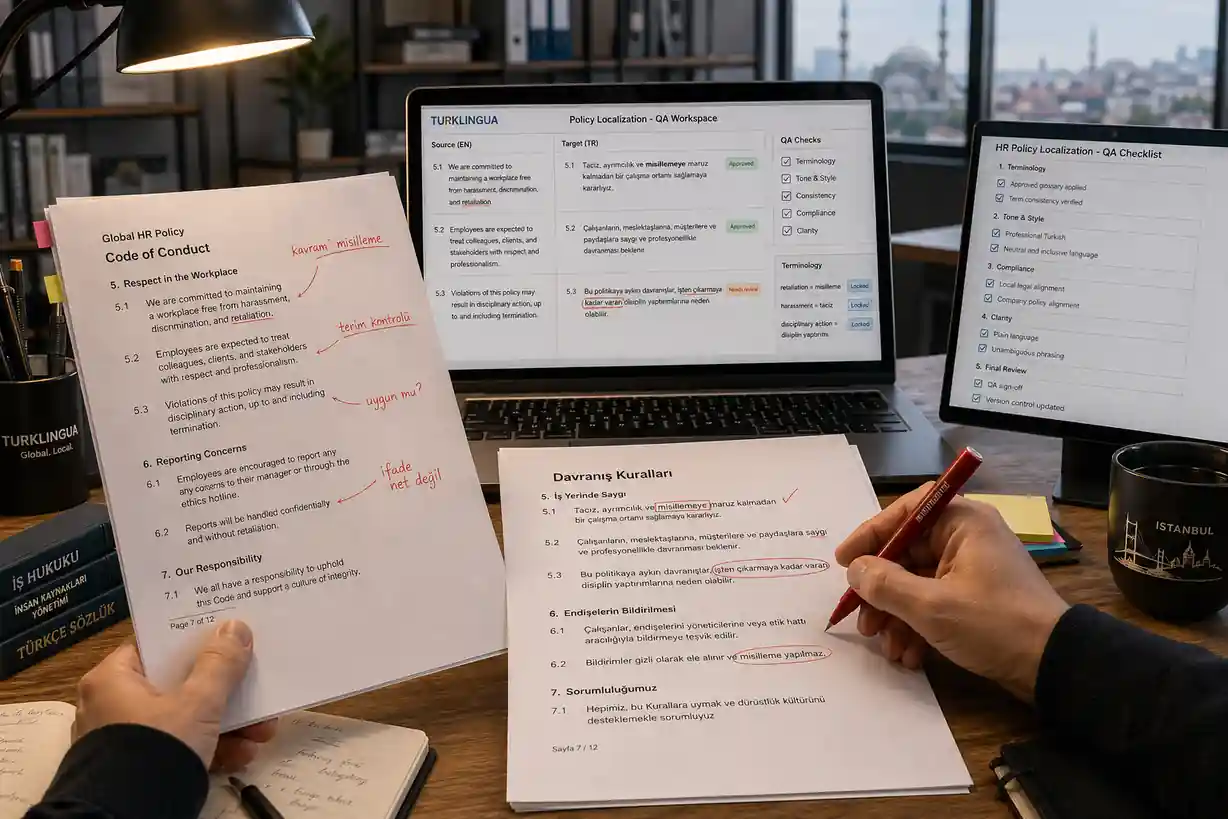
Process authority: review internal policy tone through bilingual quality assurance before employees discover the weakness for you.
FAQ
Why is HR policy localization different from normal translation?
Because HR policies affect trust, compliance, employee behavior, and internal culture. A literal Turkish version can sound legally stiff, punitive, or unclear.
What HR materials need localization?
Employee handbooks, codes of conduct, benefits guides, onboarding documents, performance review materials, training modules, and internal announcements.
Can bad HR localization create employee relations risk?
Yes. Unclear policy language can create misunderstandings around rights, duties, reporting channels, disciplinary processes, and benefits eligibility.
For broader internal-document work, review Turklingua’s Turkish localization services or request a project review through the contact page.
Make Your Turkish HR Policies Clear, Fair, and Usable
We localize HR policy language so employees understand expectations without feeling confused, threatened, or excluded. Sensitive internal materials are handled through confidential translation protocols and reviewed against quality assurance standards.
Request HR Policy Localization Review