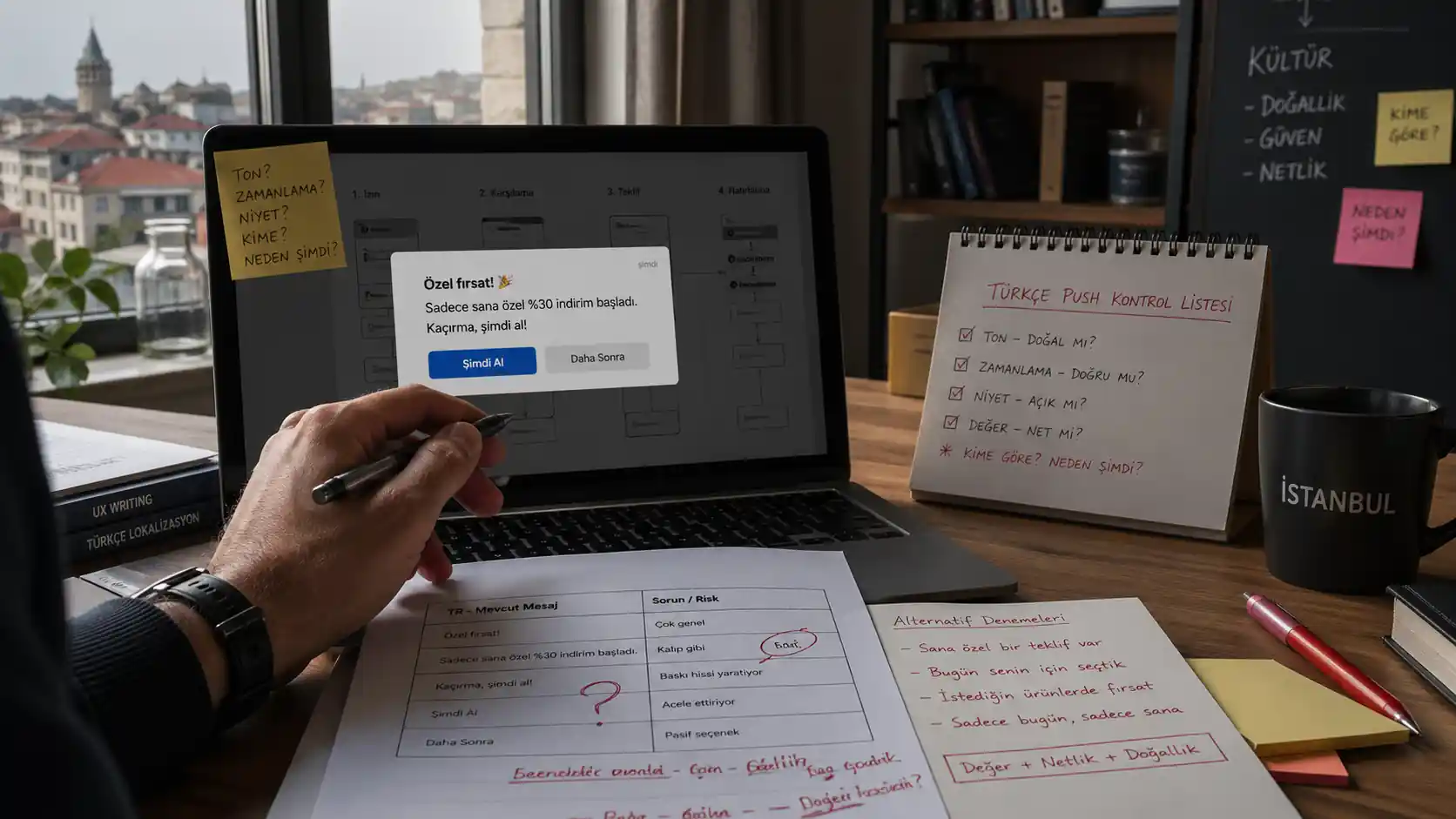
Your Push Notification Was Delivered. Your Message Was Not.
In Turkish, a notification can look translated and still fail completely because tone, timing, and intent feel wrong.
Turkish Mobile Push Notification Localization: Why Engagement Collapses After Launch
The campaign launches. Delivery rate looks fine. The notification reaches the device. The system did its job.
Then nothing happens.
Open rate is weak. Conversion from notification is lower than expected. Turkish users stop responding after the first few sends. Some disable notifications entirely.
The team looks at timing, segmentation, frequency, incentives, and app performance. All of those may matter. But one part usually gets treated as too small to investigate.
The Turkish message itself.
That is where engagement collapses quietly. Not because Turkish users hate push notifications, but because the message does not earn enough trust, urgency, or relevance in the first half-second. This is exactly why push messaging belongs inside a serious Turkish localization strategy, not at the end of a campaign checklist.
What Actually Breaks
Push notifications are often translated at the end of the workflow. Product writes the English message. Marketing approves it. Growth schedules the campaign. Then localization is asked to fit the same idea into a small character limit.
That process is already risky in any language. In Turkish, it is worse because tone changes faster. A message that sounds friendly in English may sound childish in Turkish. A reminder that sounds useful in English may sound pushy. A short CTA may sound vague instead of efficient.
The result is a notification that arrives technically but fails emotionally. The user sees it, senses that it is not quite for them, and swipes it away.
Do that enough times, and the app trains Turkish users to ignore it. That is not a simple copy issue. It is a product-language failure that needs software localization thinking, because the message is part of the user experience.
Why Turkish Changes the Risk
Turkish push notification localization has a narrow tone corridor. Too formal, and the message feels institutional and distant. Too informal, and it can sound unserious or intrusive. Too direct, and it feels like pressure. Too soft, and it gives no reason to act.
Turkish also handles urgency differently. English can use compact urgency markers like “now,” “today,” or “don’t miss.” In Turkish, direct equivalents often feel either promotional or heavy-handed unless the reason is clear.
This means the translator has to localize the situation, not only the phrase. What does the user know already? What is being asked from them? Is the action low-risk or high-risk? Is the notification informational, transactional, promotional, or behavioral?
Those categories need different Turkish voices. The work still needs linguistic precision, but it should be handled through professional Turkish translation standards that understand product behavior, not just sentence meaning.
The Business Damage You Usually Misread
The damage is measurable but often misread. Teams see weak engagement and conclude that Turkish users are less responsive, the segment is less valuable, or the campaign offer is not strong enough.
Sometimes that is true. Often it is not.
The real issue is repeated micro-distrust. Every unclear notification slightly lowers attention. Every awkward reminder lowers credibility. Every message that sounds like a translated campaign rather than a native product moment reduces the user’s willingness to respond next time.
For mobile teams, this is not a language detail. It is retention infrastructure. If the notification includes security, payment, account, or personal-data language, it also needs to align with confidentiality and security expectations so users do not read risk into a message that was meant to help them.
What Proper Turkish Localization Does Instead
The fix begins with message classification. Do not localize all push notifications the same way. Separate transactional alerts, behavioral nudges, promotional pushes, lifecycle reminders, security notices, and reactivation messages.
Each category needs its own tone rules. Security notifications need institutional clarity. Promotional messages need restraint. Re-engagement messages need relevance without guilt. Product nudges need usefulness before urgency.
Then test the Turkish version for perceived action. The question is not “Is this accurate?” The question is “Would a Turkish user understand why this matters now?” That is where bilingual quality assurance becomes a conversion safeguard, not a final typo check.
If the answer is no, the notification should not ship.
What to Audit Before Launch
Start with the notifications that affect money, account access, security, onboarding, renewal, abandoned actions, and reactivation. These are the messages where weak Turkish copy does the most damage.
Check whether each notification explains why the user should care now. Check whether the CTA is clear. Check whether the tone matches the risk level. Check whether the same feature, action, or account state is named consistently across the app, email, help center, and support macros.
A push notification has almost no time to recover from weak language. It gets one glance.
Good Turkish push localization does not shout louder. It gives the user a reason to care before they dismiss it.
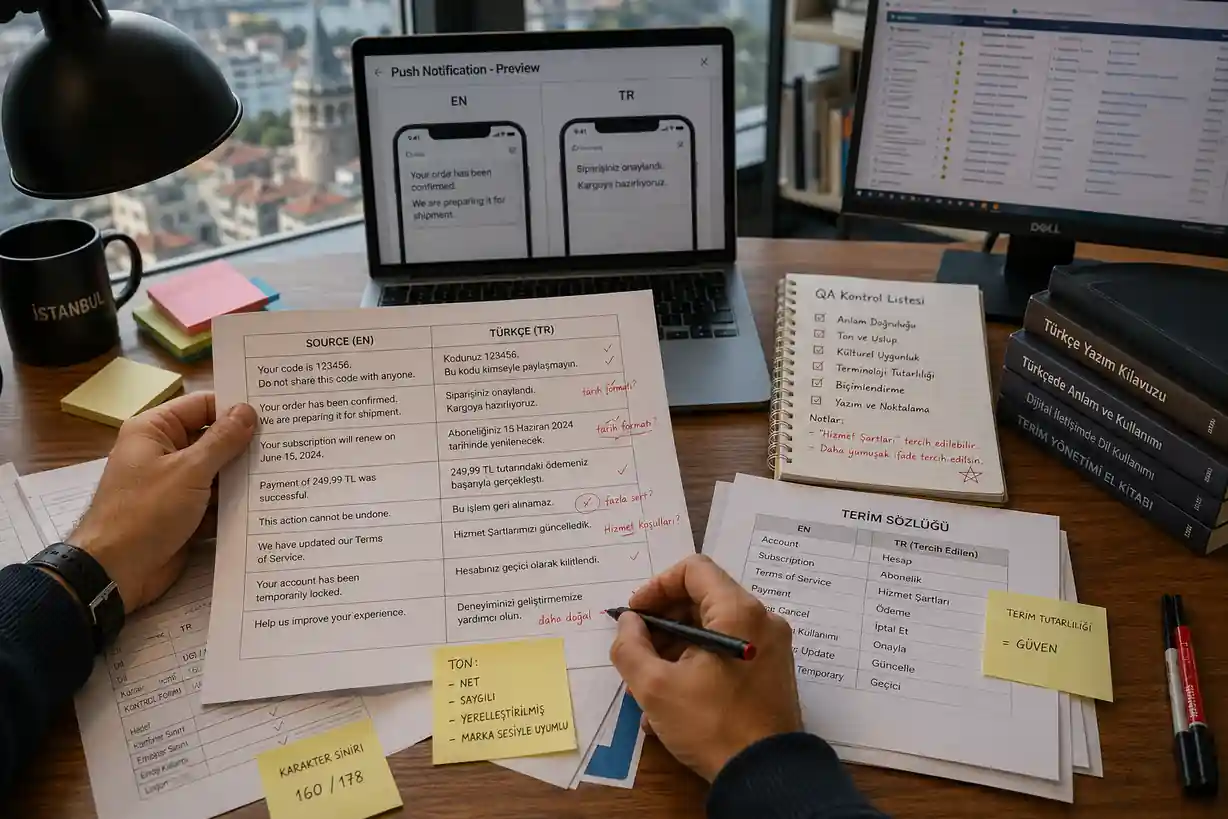
A structured Turkish review workflow checks tone, timing, action clarity, and UX risk before launch.
FAQ
Why do translated push notifications underperform in Turkish?
Because push messages are not neutral text. Turkish users judge urgency, respect, clarity, and relevance immediately. Literal translation often sounds either too cold, too aggressive, or too vague.
Should Turkish push notifications be shorter?
Not always. Shorter is useful only when meaning survives. A very short Turkish notification can become unclear, abrupt, or suspicious if it removes the reason to act.
Can push localization improve retention?
Yes. Better message intent, timing language, benefit framing, and tone consistency can increase opens, reduce dismissals, and improve the user’s willingness to keep notifications enabled. It should be reviewed as part of your Turkish localization workflow, not as isolated campaign copy.
Stop Sending Notifications Turkish Users Learn to Ignore
We help mobile teams rebuild Turkish push messaging so it earns attention instead of training users to dismiss it. For broader product flows, this connects directly to software localization and bilingual quality assurance.
Request Push Localization Review