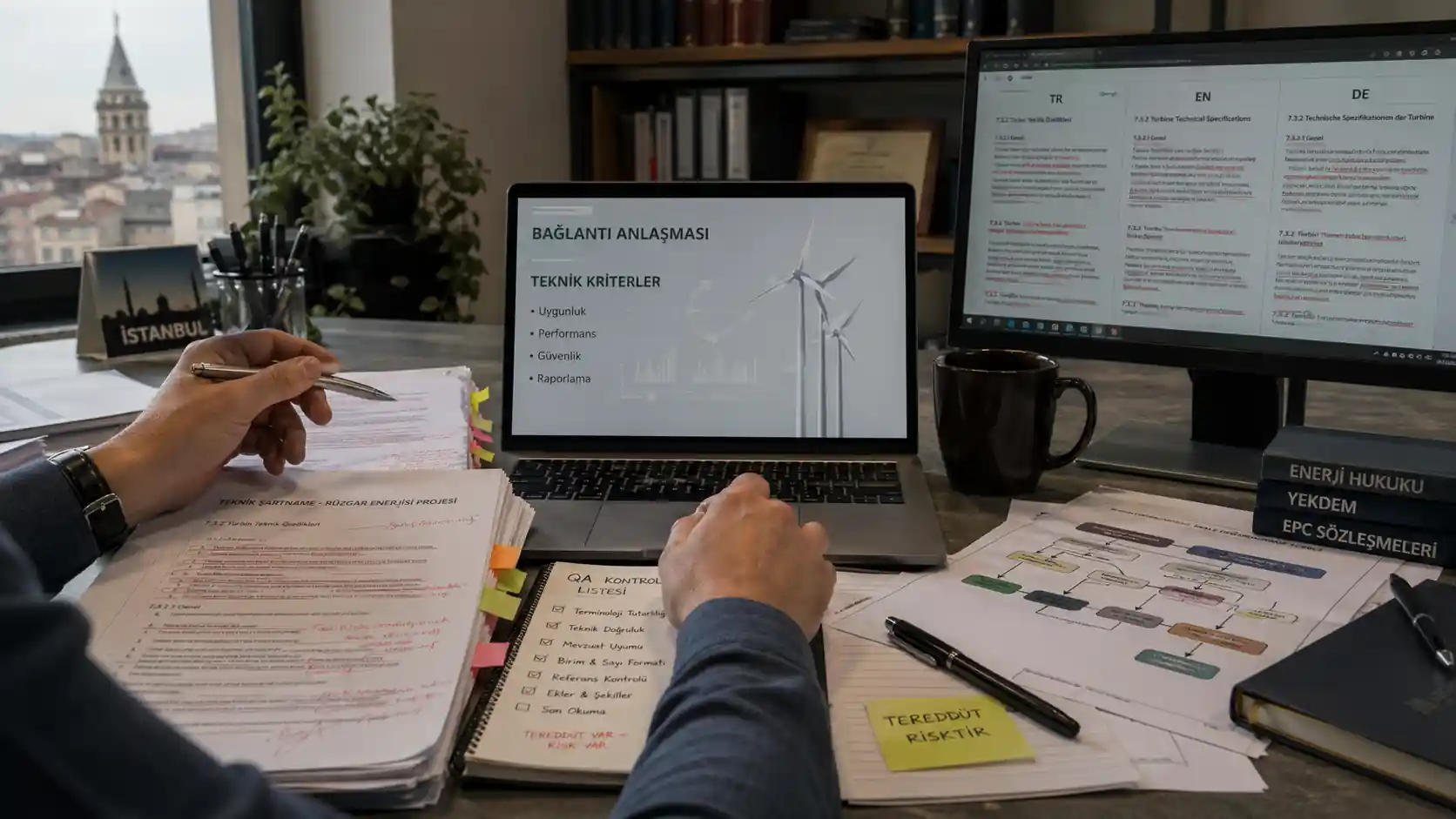
Your Energy Bid Can Look Strong and Still Read Weak in Turkish.
Technical accuracy, risk language, and proposal credibility must survive translation before the evaluator ever reaches price.
Turkish Renewable Energy Proposal Translation: Why Bids Lose Credibility Before Review
The engineering team has done the work. The numbers are strong. The technology is credible. The project team believes the proposal is competitive.
Then the Turkish version is submitted.
Nothing is obviously broken. The file opens. The sections are in place. The tables look correct. The translation reads like Turkish.
But the evaluator slows down. A technical commitment sounds less precise than it should. A responsibility statement feels softened. A risk mitigation section reads like marketing copy instead of operational control.
The bid loses force before the price is even discussed.
A Bid Is Not a Brochure
Renewable energy proposal translation sits in a difficult space. It is technical, legal, financial, and persuasive at the same time. If the Turkish version leans too far toward marketing, it loses engineering credibility. If it leans too far toward literal technical phrasing, it becomes hard to read.
Many proposal translations fail because they treat all sections the same. Executive summary, technical method, compliance response, risk allocation, delivery schedule, and O&M plan all need different language behavior.
A strong Turkish proposal must sound confident without exaggeration. It must sound precise without becoming heavy. It must preserve commitments without accidentally creating new ones.
Where Turkish Translation Weakens Bid Credibility
The most dangerous issues are rarely huge mistranslations. They are credibility leaks. A term changes between sections. A performance guarantee sounds like an intention. A delivery obligation becomes vague. A risk control phrase loses its operational force.
Turkish evaluators notice structure. They notice whether terminology is stable. They notice whether the bidder understands institutional language. They may not say “translation problem,” but confidence drops.
This is especially important in Türkiye, where infrastructure, energy, and public-facing projects often involve multiple stakeholders reading the same proposal from different angles: technical, legal, procurement, finance, and operations.
Why Renewable Energy Content Needs Sector Control
Solar, wind, storage, grid connection, EPC, SCADA, O&M, permitting, environmental compliance, and performance monitoring each carry their own terminology. A general translator may produce fluent Turkish while missing the operational hierarchy.
For example, “availability,” “yield,” “curtailment,” “commissioning,” “defect liability,” and “grid compliance” cannot be handled loosely. Each term affects how the project is understood.
A Turkish proposal also needs consistent treatment of obligations: shall, must, will, may, responsible for, subject to, provided that, unless otherwise agreed. These are not interchangeable.
The Cost of a Weak Turkish Proposal
The cost is not only losing a bid. Sometimes the proposal survives, but ambiguity creates negotiation friction later. The client asks for clarification. Legal teams revisit clauses. Technical teams re-explain scope. Procurement questions whether the bidder has control of the project.
This is wasted confidence. Proposal language should reduce perceived risk, not create it.
For international companies entering Türkiye, the Turkish proposal is often the first serious proof of local readiness. If it reads like an afterthought, the company reads like an outsider.
What Proper Turkish Proposal Translation Does
A proper workflow begins with term architecture. Project roles, technical systems, performance indicators, obligations, exclusions, and schedule terms must be fixed before translation starts.
The translator must understand the bid’s scoring logic. What matters most: compliance, technical superiority, price justification, delivery confidence, local readiness, risk management? The Turkish version should strengthen those signals.
Independent review should test whether the document still persuades. Not emotionally. Operationally. Does the reader believe the team can deliver? Does the language protect scope? Does every section sound controlled?
Internal links should point users toward Turkish technical translation services, Turkish legal translation workflows, and quality assurance standards because proposal translation lives at the intersection of all three.
Where This Connects Inside the Turklingua Site
This topic should support deeper internal authority by linking naturally into the service, quality, and confidentiality areas of the website.
- Turkish localization services
- Turkish translation quality assurance
- confidential translation protocols
- professional Turkish translation services
A renewable energy bid is not won only by engineering.
It is won by confidence.
If the Turkish proposal weakens that confidence, the translation has failed even if every sentence is readable.
The final Turkish version must make the evaluator feel that the project is controlled, the team is credible, and the risk is understood.

Process authority: review language risk before users, reviewers, or employees discover it for you.
FAQ
Why are energy proposals risky to translate into Turkish?
Because they combine technical engineering, commercial commitments, legal obligations, timelines, and tender scoring logic. Weak translation can damage credibility even when the solution is strong.
What documents are usually involved?
Technical proposals, EPC descriptions, O&M plans, method statements, compliance matrices, executive summaries, environmental sections, and contractual attachments.
Can poor Turkish wording affect bid scoring?
Yes. Evaluators may not mark it as a translation issue, but unclear technical scope, inconsistent terminology, or weak obligation language can reduce confidence in the bidder.
Protect the Bid Before It Reaches Evaluation
We review Turkish renewable energy proposal language for technical accuracy, credibility, tender consistency, and evaluator confidence.
Request Proposal Translation Review