Turklingua
Turkish Pharma IFU Localization: Why Small Wording Errors Create Regulatory Rejection Risk

One Wrong Turkish Instruction Can Turn a Safe Device Into a Regulatory Problem.

IFU localization is not document formatting. It is safety, terminology, and authority-facing clarity under pressure.

Turkish Pharma IFU Localization: Why Small Wording Errors Create Regulatory Rejection Risk

The device may be safe. The engineering may be sound. The clinical evidence may be solid. Then the Turkish IFU reaches review, and one sentence starts creating trouble.

Not a dramatic sentence. Not a visible disaster. Just a small instruction that is slightly too vague, slightly too literal, or slightly inconsistent with the rest of the document.

A reviewer notices it. A distributor questions it. A user-facing warning does not behave the way the English source intended.

That is when the project stops feeling like a translation task and starts looking like a regulatory risk.

This is the part many manufacturers underestimate. IFU localization is not about making English instructions readable in Turkish. It is about preserving safety behavior, sequence, responsibility, and regulated meaning in a language that does not tolerate fuzzy instruction logic.


What Actually Breaks

The common failure starts late. Usually too late. A company translates the IFU after the product language is already frozen. The English source is approved. The deadline is tight. Someone assumes the Turkish version is a downstream formatting step.

Then the Turkish version introduces tiny cracks. A warning uses a general verb instead of a controlled action. A device component is named one way in the diagram and another way in the instructions. A conditional instruction loses the exact sequence of what happens before and after use.

Nobody panics at first because the page still looks professional. The layout is correct. The glossary appears mostly consistent. The sentences read naturally.

But regulatory and safety documents do not fail only when they look wrong. They fail when the user action becomes less controlled than the source intended.


Why Turkish Changes the Risk

Turkish changes the risk profile because the language demands different decisions from the writer. English can hide ambiguity inside compact phrases. Turkish often forces the translator to choose the relationship between actor, action, condition, and consequence.

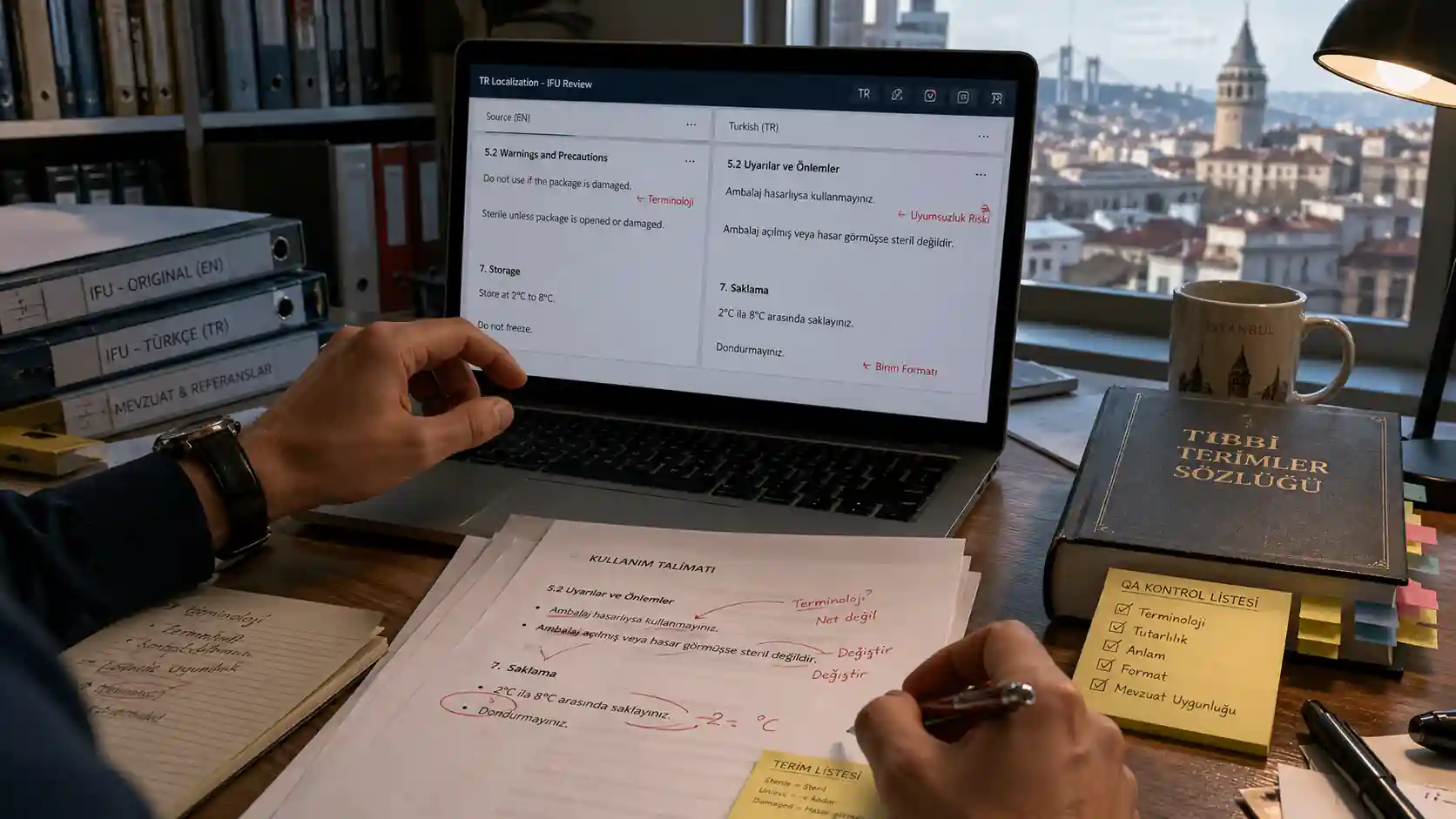
That is especially dangerous in IFU content. A phrase like “do not use if damaged” may look simple, but the Turkish version has to decide what is damaged, who observes it, whether the condition is prior to use, and how direct the prohibition should sound.

The same applies to sequence markers. “Before use,” “during use,” “after use,” “if observed,” and “unless instructed” cannot be handled casually. Turkish readers need clear order. Reviewers expect the same. If the instruction feels loose, the document feels uncontrolled.

This is why professional Turkish pharma and medical device localization has to be closer to controlled technical writing than ordinary translation.


The Business Damage You Usually Misread

The business damage is rarely described as “translation damage.” It appears as a delayed submission, a distributor query, a regulator comment, a rework cycle, or a last-minute escalation before launch.

That delay is expensive. Not only because of the linguistic correction itself. The real cost is cross-functional interruption: regulatory affairs, QA, product, legal, distributor, and labeling teams all get pulled back into a document they thought was finished.

For global companies entering Türkiye, this is especially painful. The Turkish market is not the problem. The problem is that the documentation was not localized with the same seriousness as the product.


What Proper Turkish Localization Does Instead

The fix starts before translation. You need controlled terminology for device parts, warning categories, user actions, contraindications, and recurring safety verbs. This is not optional. If these terms are not fixed before production, consistency becomes luck.

Then the IFU must be translated with user action in mind. Every sentence should answer three questions: who does what, when do they do it, and what happens if they do not. If the Turkish sentence cannot answer those questions clearly, it is not ready.

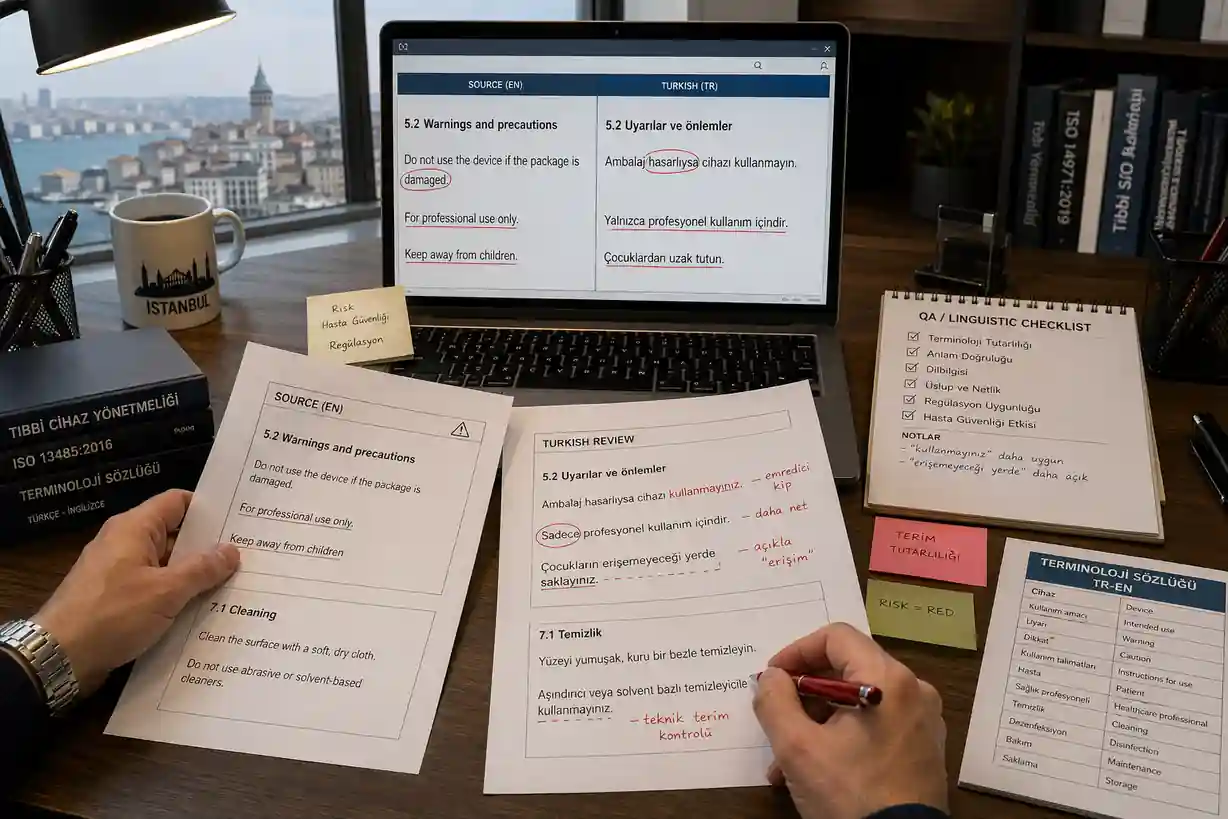
Independent review matters. A second linguist should check safety logic, terminology consistency, diagram references, numbering, conditional phrasing, and readability. This is where a professional Turkish translation workflow protects the project from invisible drift.


Strategic Internal Links for This Topic

This page should not stand alone. It should reinforce the broader authority cluster around Turkish localization, regulated translation, quality assurance, and confidential project handling.


A good Turkish IFU does not sound clever. It sounds controlled.

It tells the user exactly what to do. It tells the reviewer that the documentation is disciplined. It tells the manufacturer that the product is not being weakened at the language layer.

That is the standard. Anything less is not localization. It is exposure.

Turkish Pharma IFU Localization: Why Small Wording Errors Create Regulatory Rejection Risk QA workflow

A structured Turkish review workflow makes invisible risk visible before launch.

FAQ

Why is IFU localization risky in Turkish?

Because Turkish safety instructions require explicit sequencing, precise terminology, and unambiguous user action. A literal translation can sound fluent while changing the practical meaning of a warning or instruction.

Is IFU localization only for medical devices?

No. The same risk logic applies to pharma packaging, patient leaflets, device manuals, training inserts, and regulator-facing supporting documentation.

Can terminology inconsistency cause rejection?

Yes. If the same device part, warning category, dosage condition, or usage instruction appears differently across the document set, reviewers may question control, consistency, and safety understanding.

Protect the Submission Before It Reaches the Reviewer

We review Turkish IFU language for safety clarity, regulatory consistency, and user comprehension before small wording errors become submission delays.

Request IFU Localization Review