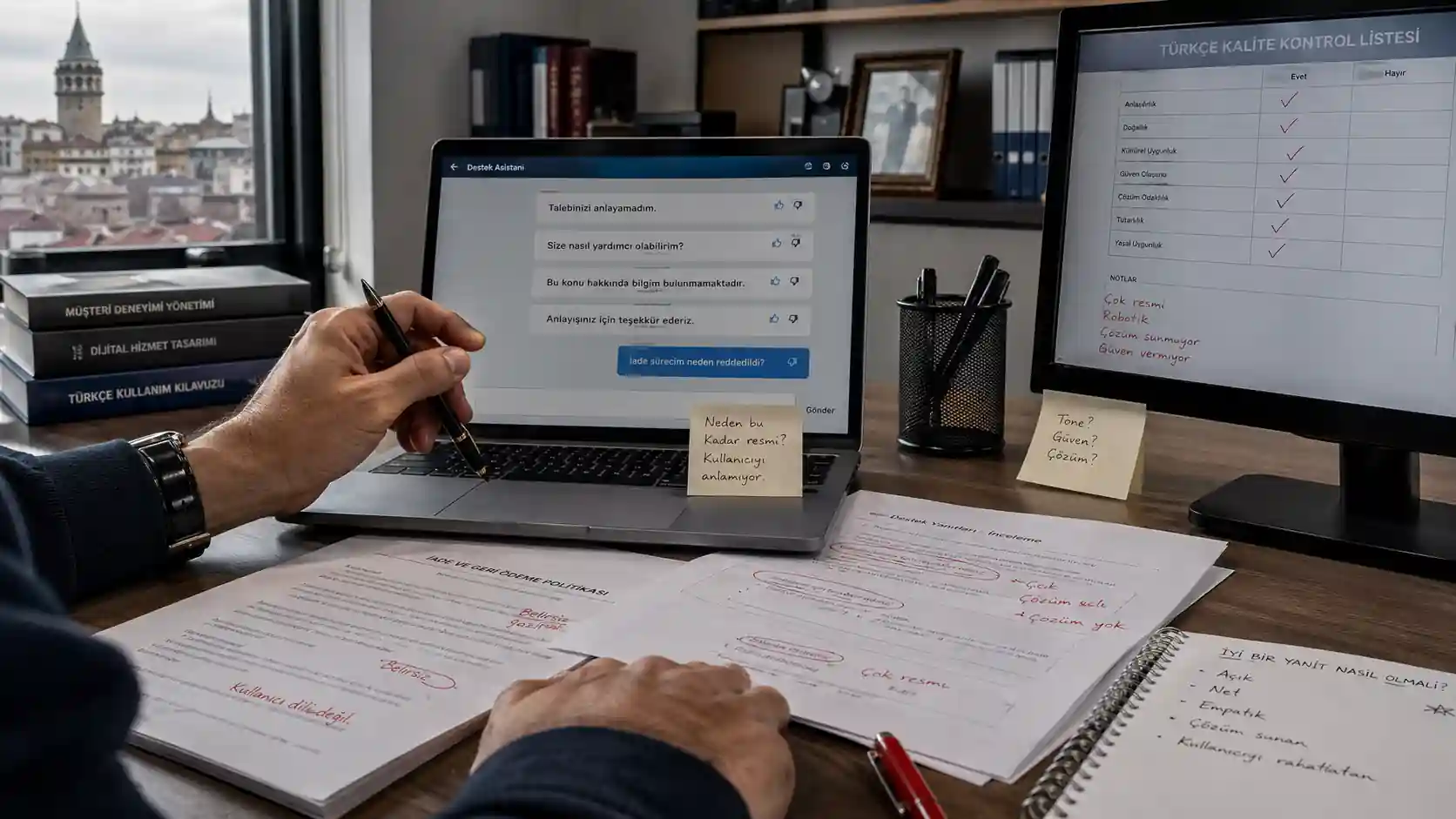
Your Turkish Chatbot Answers. The User Still Doesn’t Believe It.
Automated support fails in Turkish when the answer sounds translated, evasive, or institutionally unsafe.
Turkish AI Chatbot Localization: Why Users Stop Trusting Automated Support
A customer opens your support chat in Türkiye. They are already slightly annoyed. Something did not work, a payment looks unclear, an order is delayed, or an account setting feels risky.
The chatbot answers in Turkish. The grammar is fine. The sentence is readable. Nobody on the product team sees an obvious problem.
But the user asks again. Then again. Then types “temsilciye bağlanmak istiyorum.” They do not trust the bot. They do not trust the answer. Sometimes, they do not trust the company anymore.
That is where AI chatbot localization becomes a business problem, not a language task. It sits directly inside your broaderTurkish localization strategy, not outside of it.
The Failure Is Not the Bot. It Is the Turkish Conversation Logic.
Most AI chatbot localization projects begin with strings, prompts, intents, and fallback messages. The team exports the content. A translator translates it. The result is deployed. Technically, the job is finished.
But customer support is not a static text environment. It is a pressure environment. The user is looking for reassurance, responsibility, and a clear next step. Turkish support language has to satisfy those expectations quickly.
A direct translation often keeps the surface meaning while losing the support function. This is exactly why companies that invest inprofessional Turkish translation still see support failures if conversational logic is ignored.
For example, an English fallback like “I’m sorry, I didn’t get that” is harmless. A literal Turkish equivalent can sound mechanical, cold, or dismissive if repeated. In a support context, repetition feels like avoidance.
Why Turkish Makes Chatbot Trust More Fragile
Turkish carries formality, distance, certainty, and responsibility differently from English. A chatbot that uses the wrong level of formality may sound rude, childish, overly bureaucratic, or strangely artificial.
Support language also needs controlled responsibility. Turkish users want to know whether the system understands the issue, whether the company accepts ownership, and whether a human will intervene if needed.
If the bot says too little, it feels evasive. If it says too much, it feels scripted. If it apologizes without solving anything, it feels hollow.
This is why chatbot flows must be reviewed with the same rigor astranslation quality assurance processes, not treated as UI text.
What Companies Misread in the Metrics
The dashboard rarely says “localization failure.” It says containment failed, repeat contact increased, escalation rate is too high, CSAT dropped, or users abandoned the chat.
Teams then tune the bot model, retrain intents, adjust routing, or rewrite knowledge base content. Those may help. But if the Turkish response itself does not create confidence, the same problem remains.
This is especially dangerous for brands entering Türkiye. Early customer support experiences define trust, and that trust depends heavily on consistent terminology, tone, and secure handling of user data underconfidentiality and security standards.
What Proper Turkish AI Chatbot Localization Should Do
A strong Turkish chatbot flow does not simply translate answers. It rebuilds conversational trust. Every answer should clarify what the bot understood, what the user should do next, and when a human will take over.
Escalation language must be explicit. Users need to know whether the matter requires an agent, what information is needed, and whether the issue is being recorded.
Terminology must match your help center, app UI, policy documents, and transactional emails. If the bot uses one phrase and the app uses another, trust weakens — this is a classic breakdown between localization and real operational language systems.
What to Audit Before You Scale AI Support in Türkiye
Start with the top 50 Turkish conversations by volume and the top 20 by business risk. Do not start with the whole bot. Start where trust breaks.
Then connect chatbot behavior to your broader Turkish content ecosystem — localization, translation, QA, and customer communication — so everything behaves like one system.
A chatbot can answer and still fail.
In Turkish, the user is not only reading the answer. They are judging whether the company is safe, serious, and present.
Good Turkish AI chatbot localization fixes the moment before the user gives up.
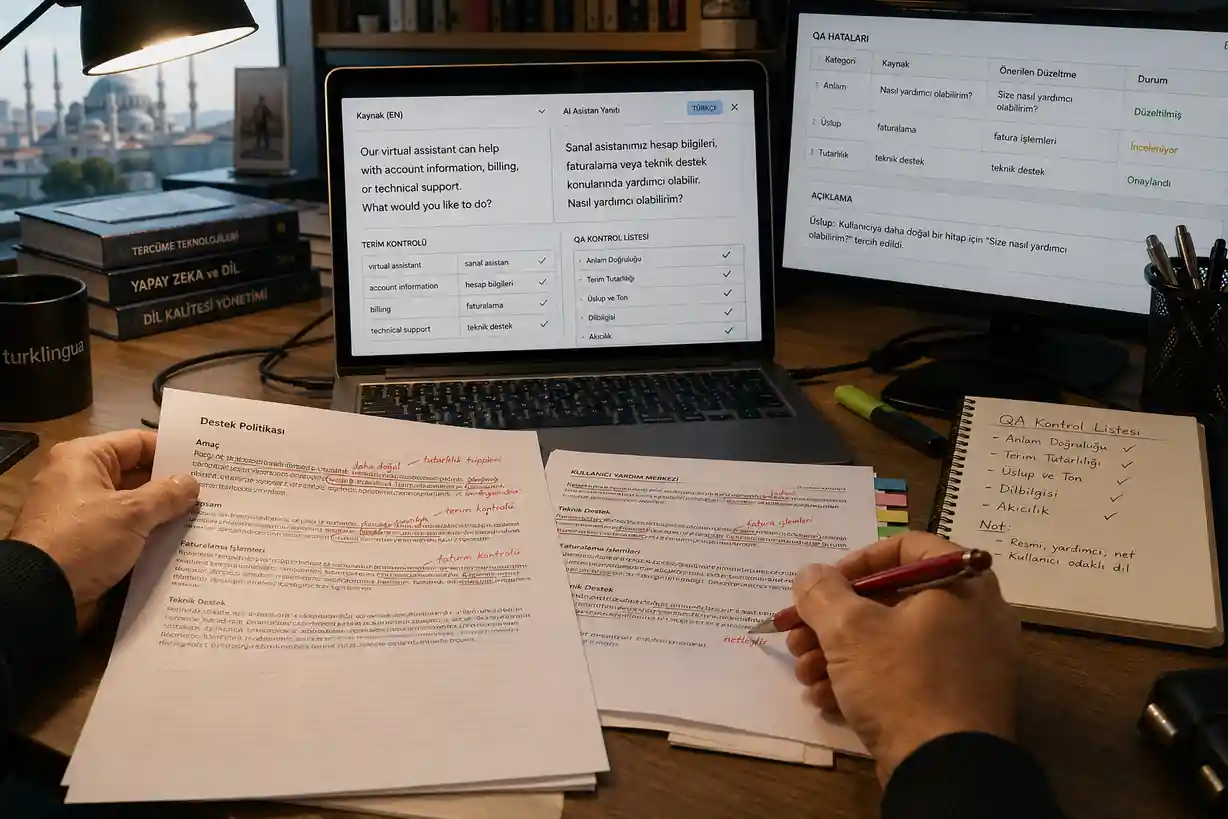
Process authority: review language risk before users, reviewers, or employees discover it for you.
FAQ
Why do Turkish chatbot answers lose trust?
Because Turkish users judge responsibility, tone, and clarity quickly in support contexts. A grammatically correct answer can still feel evasive, automated, or unsafe.
Is chatbot localization just prompt translation?
No. It includes intent mapping, escalation wording, fallback behavior, terminology, politeness level, and the emotional logic of a support conversation.
Can chatbot localization reduce support tickets?
Yes. When the Turkish flow answers the real user concern and escalates at the right point, users are less likely to repeat questions or abandon the channel.
Make Your Turkish Chatbot Sound Trustworthy Enough to Use
We review chatbot flows for intent, tone, escalation logic, and Turkish conversational trust before automation damages support credibility.
Request Chatbot Localization Review