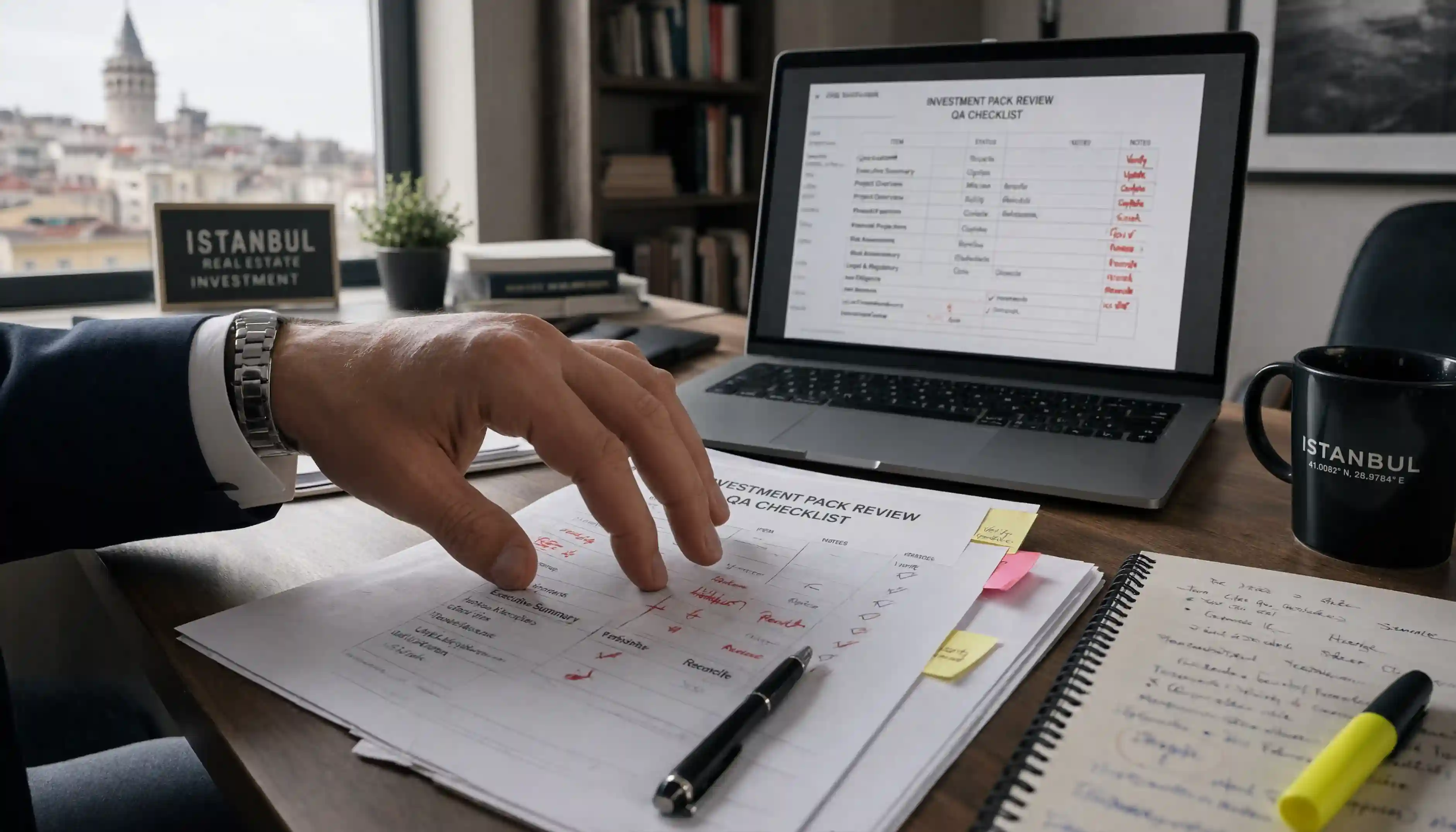
Finance, Banking, Fintech, and Investor Communications
The Asset Looks Strong. The Turkish Investor Pack Still Raises Doubt.
Investment packs must preserve financial logic, legal boundaries, asset risk, and local credibility in Turkish.
Turkish Real Estate Investor Pack Translation: Why Due Diligence Confidence Breaks Before the Deal
An investor reviews a Turkish investor pack and decides whether diligence risks are visible enough to continue. At that moment, the Turkish wording is not decoration. It decides whether the reader can verify, invest, continue, approve, transfer, disclose, or accept a financial condition without asking someone else to explain the source text.
The risk is rarely a spelling mistake. The risk is that property, title, zoning, tax, and valuation language does not support confident diligence. That is why real estate investor pack translation belongs inside a controlled Turkish content system, alongside fintech translation for Turkish markets, bilingual quality assurance, and terminology consistency checks.
A generic translation pass may make the page readable. It will not necessarily preserve the business function. The Turkish version must carry the same obligation, urgency, reassurance, evidence, and action logic that the original asset was designed to create.
Why This Page Is Bottom-of-Funnel, Not Generic Awareness Content
Buyers searching for this topic already understand that Turkish is a market, a legal environment, and a decision context. They are not looking for a broad vendor claim. They are trying to prevent misunderstood obligations, lower conversion, complaint escalation, investor hesitation, and compliance exposure.
The page therefore needs to answer the operational question behind the keyword: what exactly can go wrong in Turkish, where does that weakness appear, who notices it first, and how should the review workflow catch it before publication or submission?
In practical terms, the content should connect to digital banking, linguistic risk assessment, investment prospectus translation, and Turkish localization services. Those links are not decorative SEO links. They help a real buyer move from risk recognition to scope definition.
The Turkish Failure Pattern
English source text often relies on context that internal teams already know. Product, legal, medical, engineering, marketing, or compliance stakeholders may understand the shorthand. A Turkish reader does not receive that private context.
The Turkish page has to make the hidden logic visible. It must show what is required, what is optional, what is excluded, what happens next, and what evidence supports the claim. If the reader has to infer those points, the page is doing too little.
This is why real estate investor pack translation should be reviewed as risk disclosures, onboarding flows, alerts, financial reports, investor updates, compliance notices, and transactional messaging. Every heading, verb, field label, warning, note, CTA, caption, and metadata field should serve the same decision.
The visible symptom may appear as conversion rate, escalation rate, complaint rate, approval delay, support volume, and stakeholder confidence. Teams often treat those numbers as product, support, or campaign problems. In many cases, the Turkish language layer is one of the first places to check.
What a Serious Turkish Review Should Check
A publication-ready review must go beyond fluency. It should test whether the Turkish reader can complete the intended decision with no private knowledge of the source team’s assumptions.
- risk wording
- numerical consistency
- action verbs
- regulatory terminology
- user trust language
- conditional logic
- disclosure prominence
- cross-channel consistency
This is where the difference between ordinary translation and controlled localization becomes visible. The reviewer is not only asking whether the sentence is correct. The reviewer is asking whether the Turkish sentence still performs the same work.
For high-risk assets, the review should include source files, screenshots, style guides, termbases, previous Turkish assets, and reviewer comments. Without those references, the Turkish version may sound smooth while drifting away from product behavior, legal boundaries, clinical context, technical sequence, or brand intent.
How to Brief the Project Before Translation Starts
The strongest brief starts with the decision moment. Define who reads the Turkish asset, what they need to believe, what they must do, and what cannot be misunderstood. Then define the connected assets that must use the same terminology.
For fintech product teams, compliance officers, investor relations teams, banking marketers, and legal reviewers, that usually means sending source files, screenshots, prior Turkish wording, glossaries, brand voice rules, legal or regulatory notes, and any existing terminology exceptions before translation begins.
The team should also identify forbidden shortcuts. Some English phrases look efficient but become vague in Turkish. Some legal formulations look safe but become too heavy for a user interface. Some marketing claims sound confident in English but require more evidence or a different tone in Türkiye.
Internal Links That Support the Buyer Journey
This topic sits inside a larger Turklingua service ecosystem. The following related pages help buyers scope the work, understand the review controls, and connect this specific risk to adjacent Turkish translation and localization needs.
- fintech translation for Turkish markets
- digital banking
- payment systems
- banking, finance and capital markets
- financial regulations
- compliance and KYC translation
- banking regulation translation
- investor relations presentation translation
- investment prospectus translation
- Turkish localization services
- professional human Turkish translation
- bilingual quality assurance
What Publication-Ready Turkish Should Achieve
The final Turkish version should feel built for the Turkish decision, not retrofitted from a foreign source. It should make the next step visible, preserve the intended level of certainty, and remove preventable doubt at the exact point where doubt becomes expensive.
That is the commercial value of expert Turkish language work. It protects conversion, trust, compliance, safety, and stakeholder confidence at the same time. A page can rank and still fail if it does not help the buyer act.
For this reason, Turklingua treats real estate investor pack translation as a controlled business asset. The goal is not only to publish Turkish content. The goal is to make the Turkish reader confident enough to take the intended next step.
If your Turkish asset affects approval, adoption, safety, claims, procurement, revenue, or trust, it deserves a focused review before launch. Start with the riskiest page, flow, document, or message, then expand the termbase and review pattern across the connected content set.
To scope the work, share the source asset, target audience, connected Turkish pages, intended publishing channel, and any reviewer requirements. Turklingua can then assess whether the project needs translation, localization, transcreation, bilingual QA, terminology work, or a combined workflow. You can professional human Turkish translation when the asset is ready for review.

Process authority: Real Estate Investor Pack Translation is reviewed for terminology, decision logic, connected-asset consistency, and Turkish-market clarity before publication.
FAQ
Why is real estate investor pack translation high-risk in Turkish?
Because the Turkish reader needs to verify, invest, continue, approve, transfer, disclose, or accept a financial condition in a real decision moment. A fluent sentence can still weaken certainty, responsibility, evidence, or next-step clarity.
Why is ordinary translation not enough?
Ordinary translation may preserve surface meaning while missing the function of risk disclosures, onboarding flows, alerts, financial reports, investor updates, compliance notices, and transactional messaging. The Turkish version must be tested against the business outcome, not only grammar.
What should be reviewed before launch or submission?
Terminology, action verbs, risk language, sequence, metadata, structured data, connected assets, screenshots, forms, and the reader’s ability to complete the intended next step.
Who should be involved in the Turkish review?
The review should involve a senior Turkish linguist, a project manager, and where needed a subject-matter reviewer familiar with finance, banking, fintech, and investor communications.
What should we send to scope the project?
Send the source files, screenshots or PDFs, intended audience, deadline, existing Turkish terminology, preferred tone, connected pages, and any legal, regulatory, technical, or brand constraints.
Make Your Turkish Real Estate Investor Pack Translation Ready for Real Buyers
Turklingua reviews terminology, tone, workflow logic, metadata, internal links, and decision-stage clarity so your Turkish content supports trust before it goes live.