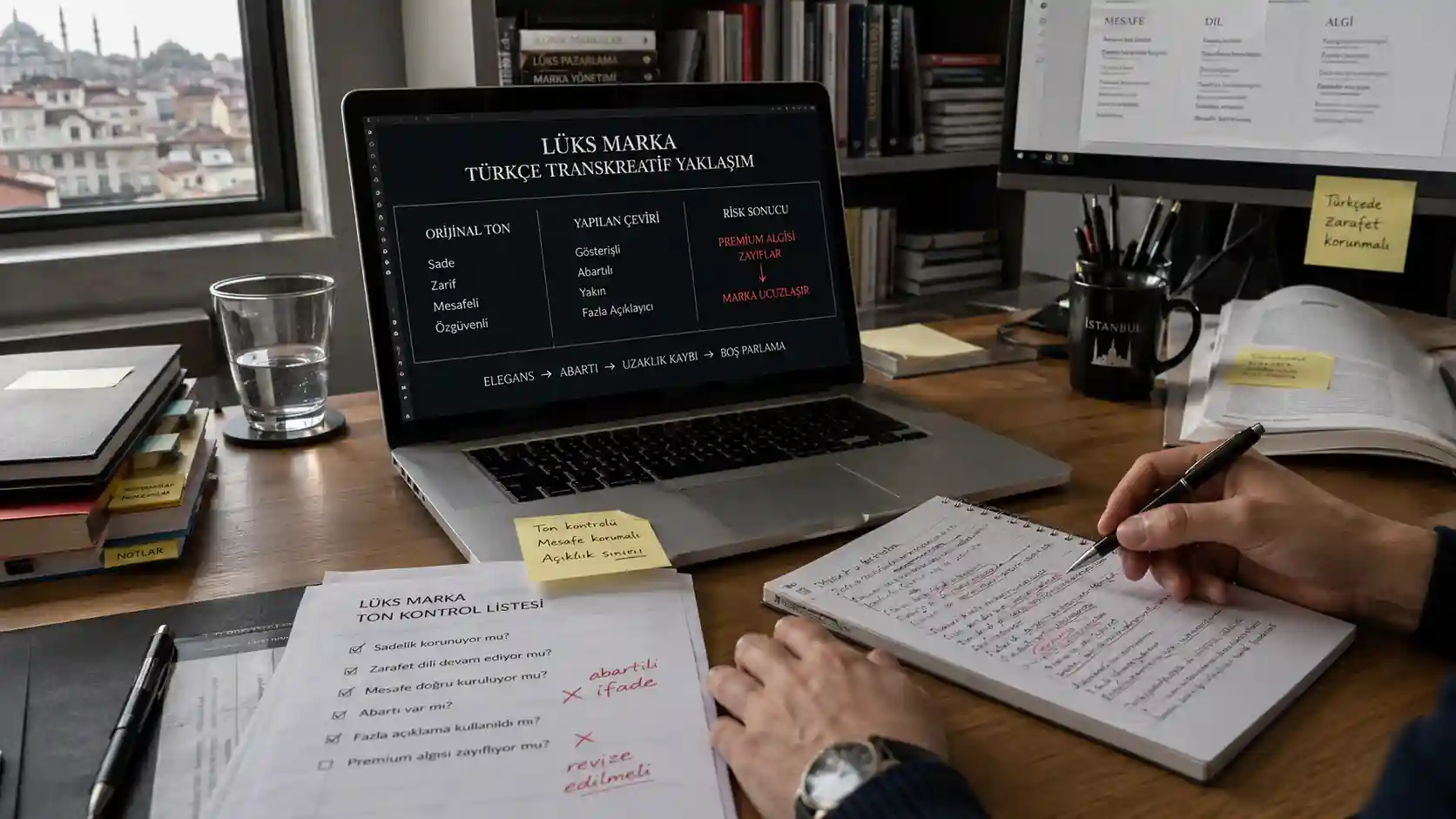
Luxury Copy Does Not Survive Translation by Looking Expensive.
In Turkish, premium positioning collapses when elegance becomes exaggeration, distance, or empty polish.
Turkish Luxury Brand Transcreation: Why Premium Positioning Gets Cheapened in Translation
The global campaign is beautiful. The photography is controlled. The English copy is minimal, confident, and expensive in the right way.
Then the Turkish version appears.
Nothing is obviously wrong. The words are accurate. The page looks polished. The product names are correct.
But the copy feels different. A quiet luxury phrase becomes loud. A restrained promise becomes generic. A sophisticated tone becomes stiff. The brand suddenly sounds less premium.
That is what happens when luxury copy is translated as ordinary content instead of handled through a controlled Turkish localization strategy built around tone, audience, and market perception.
What Actually Breaks
Luxury marketing copy works through restraint. It does not explain too much. It does not beg. It does not overstate. It creates desire through precision and silence.
Direct Turkish translation often fills that silence with extra weight. The sentence becomes heavier. The adjective becomes broader. The promise becomes more promotional.
The product may still sound good, but the brand signal changes. That is the risk. Luxury can be damaged without any visible linguistic error, especially when the work is treated as simple professional Turkish translation rather than transcreation.
Why Turkish Changes the Premium Signal
Turkish can express elegance beautifully, but it punishes false grandeur. Imported luxury copy can easily sound theatrical, exaggerated, or distant if the register is wrong.
The transcreator has to decide how much formality to use, how much sensory language to keep, how direct the claim should be, and where restraint should replace literal meaning.
A phrase that sounds refined in English may need a completely different Turkish structure to produce the same feeling. This is why premium copy must be reviewed against brand voice, not only grammar.
The Business Damage You Usually Misread
Weak luxury localization does not always reduce sales immediately. It erodes positioning. Customers may still understand the product, but the brand feels less exact, less intimate, less confident.
For premium brands entering Türkiye, this matters. A local audience can sense when copy was translated from outside the market. The brand begins to feel imported in the wrong way: present, but not truly speaking.
That weakens campaign credibility, product desirability, retail experience consistency, and every later touchpoint that depends on trust in the brand’s Turkish voice.
What Proper Turkish Luxury Transcreation Does Instead
A strong workflow begins with brand voice mapping: restraint level, emotional temperature, product vocabulary, sensory language, forbidden words, and claims that must not become inflated.
Then the Turkish copy is rebuilt for effect. Some phrases become shorter. Some become quieter. Some require a different structure. Some should not be translated at all.
The goal is not to sound Turkish in a generic sense. The goal is to make the brand feel premium inside Turkish without losing its original authority. That requires the same discipline used in translation quality assurance, but applied to brand signal, rhythm, and cultural fit.
What to Audit Before Campaign Launch
Check every adjective. Luxury copy often fails through adjectives before it fails through meaning. Remove words that sound broad, loud, or overused.
Check rhythm. Turkish premium copy often needs controlled pacing. Too many clauses can make it feel heavy. Too much brevity can make it feel cold.
Check the full journey: hero copy, product pages, email, store signage, packaging, social captions, and customer service scripts. Premium positioning has to stay consistent everywhere.
For unreleased collections, campaign materials, pricing documents, and launch plans, the review should also respect confidential project handling from the first file transfer.
Luxury translation is not about making copy beautiful.
It is about protecting the signal.
The Turkish version must feel controlled, desirable, and culturally fluent without sounding like it is trying too hard.
That is transcreation. Anything else is decoration.
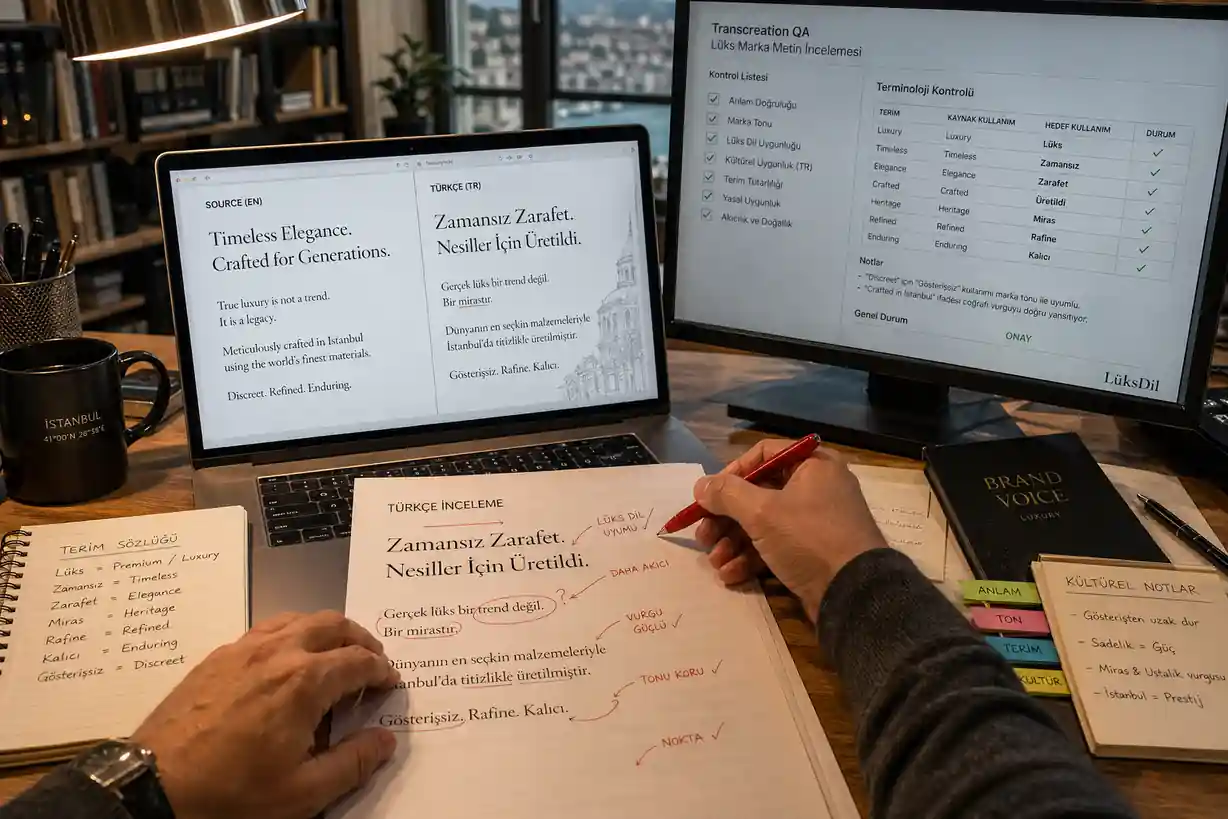
Process authority: brand voice, terminology, tone, and market fit reviewed before premium positioning is weakened in Turkish.
FAQ
Why does luxury copy need transcreation?
Because luxury depends on tone, restraint, rhythm, and cultural signal. Literal Turkish translation often sounds inflated, generic, or emotionally wrong.
What usually goes wrong in Turkish luxury localization?
Claims become too loud, elegance becomes stiffness, exclusivity becomes arrogance, and product copy loses sensory precision.
Can transcreation preserve brand voice?
Yes. It rebuilds the persuasive effect in Turkish while protecting positioning, tone, product value, and audience expectations.
For broader Turkish market adaptation, see our Turkish localization services.
Protect the Premium Signal in Turkish
We transcreate Turkish luxury brand copy so tone, restraint, exclusivity, and cultural nuance survive the market shift.
Request Luxury Brand Transcreation Review