Expert Guide
Financial Statement Translation Is Risk Control
Financial statements are not ordinary business documents. They are read by auditors, boards, investors, lenders, legal teams, and regulators. The Turkish version has to preserve numbers, notes, terminology, disclosure logic, and the confidence of the people reviewing it.
Best For
Audit firms, CFO offices, investor relations teams, private equity teams, banks, and listed companies that need Turkish financial accuracy.
Main Risk
Weak financial statement translation can distort disclosures, delay audit review, weaken investor confidence, or create version-control problems.
Core Solution
Finance-aware translation, terminology control, independent revision, table checks, number checks, and final QA before delivery.
What Is Financial Statement Translation?
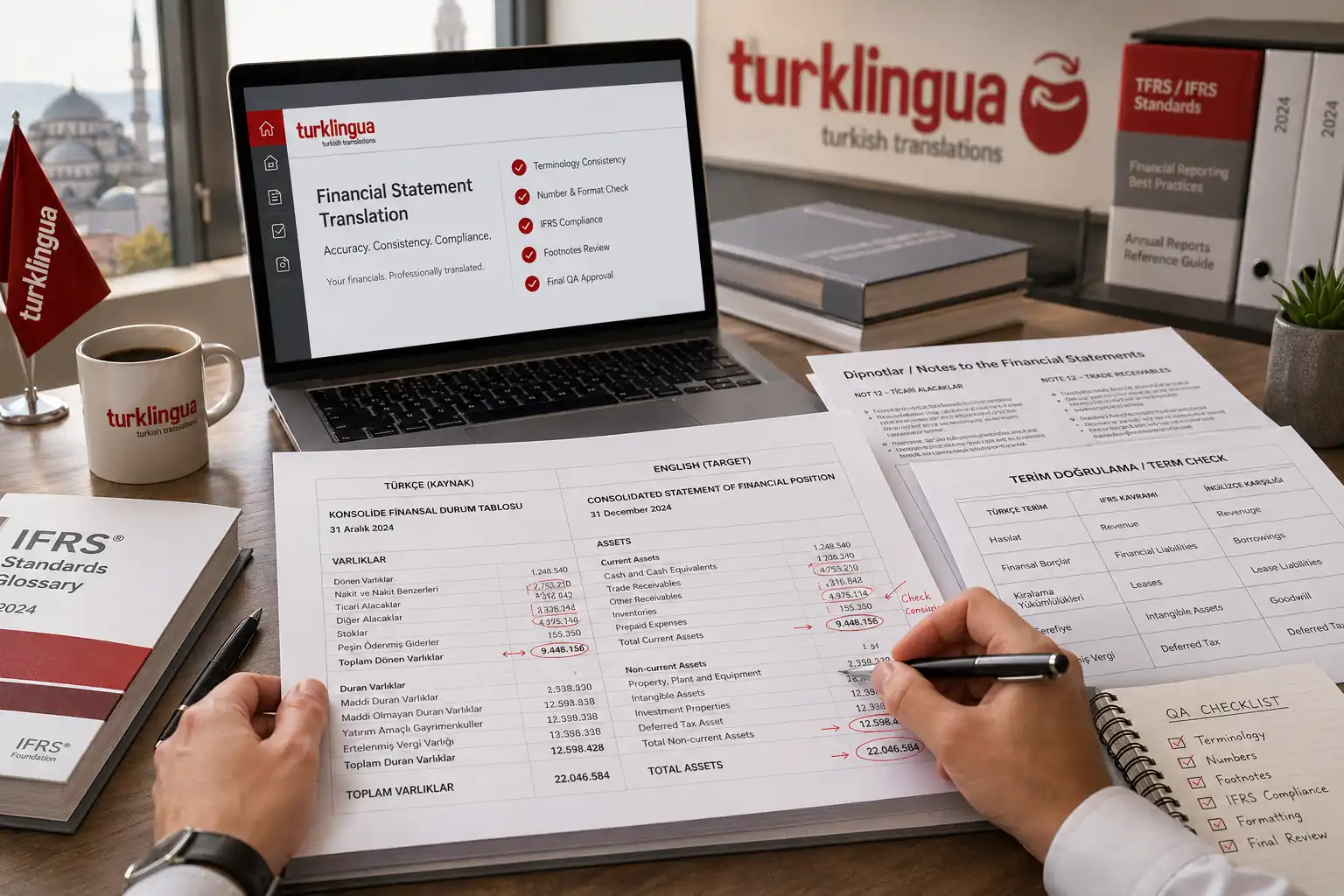
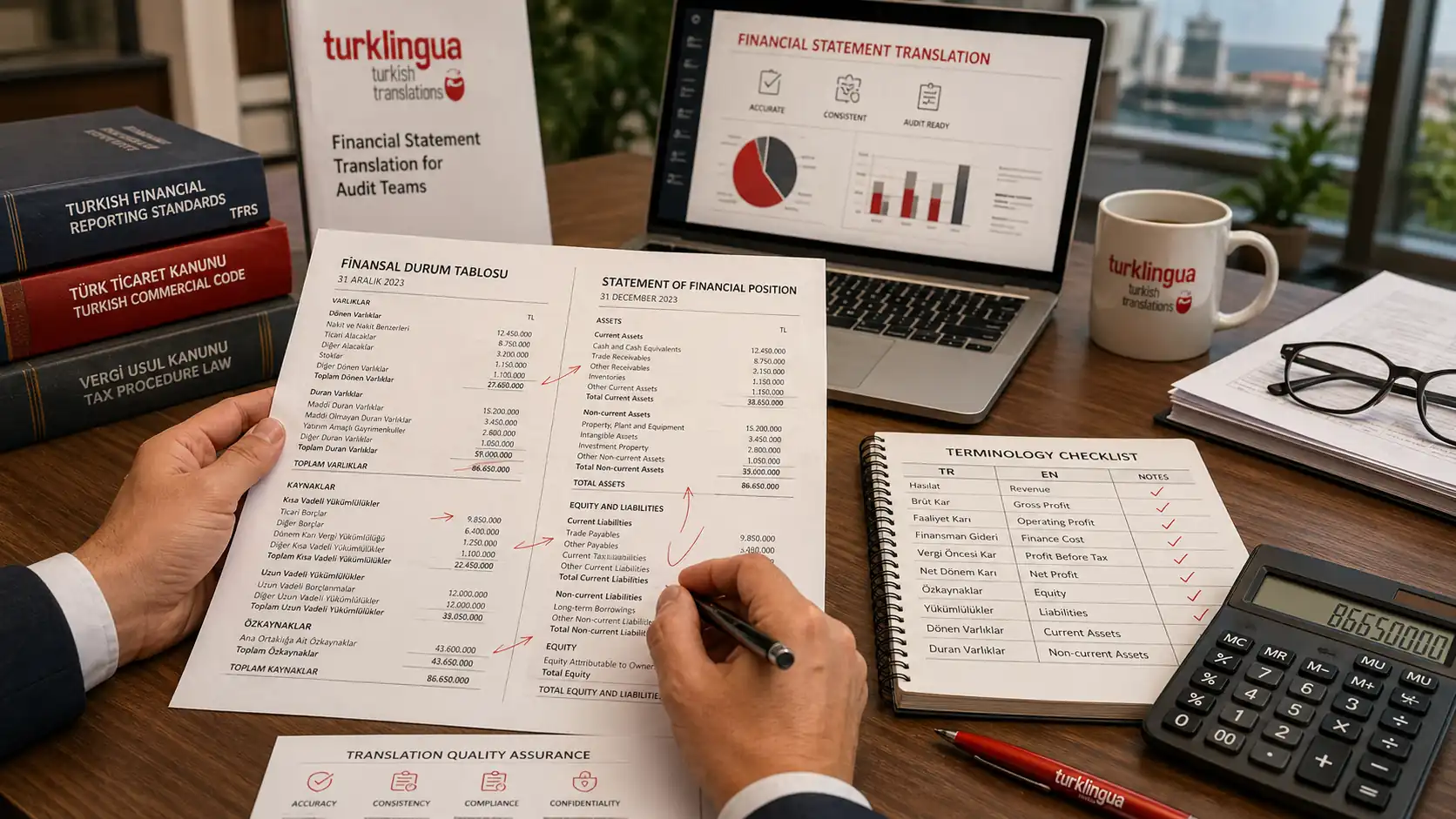
Financial statement translation is the careful transfer of audited or unaudited financial reporting content into Turkish while preserving figures, note structure, terminology, formatting, and the commercial purpose of the original material.
It is different from ordinary translation because the reader is not only trying to understand the text. They may be checking disclosures, testing assumptions, comparing reporting periods, reviewing audit comments, preparing investor material, or supporting a filing.
That is why high-value finance projects should be handled through professional Turkish translation, not a generic low-control workflow that treats tables and disclosures as simple text.
The Turkish version should not merely read well. It should let auditors, finance teams, and stakeholders verify the same financial meaning.
Who Needs This Service?
This service is designed for organizations that need Turkish financial reporting content to be trusted by internal reviewers, external auditors, lenders, investors, lawyers, regulators, or board members.
The highest-risk projects usually involve deadlines, recurring line items, IFRS language, group reporting packs, audit notes, investor-facing summaries, or financial documents that will be reused across multiple stakeholder groups.
Financial statement projects often sit inside the broader banking, finance, and capital markets translation cluster, where terminology and disclosure discipline matter as much as fluency.
Common Documents and Content Types
The correct workflow depends on the file type. An audit report, a note to the accounts, a management commentary section, and an investor deck do not carry the same review burden.
Typical Project Materials
- Financial statements
- Audit reports
- Notes to the accounts
- Management discussion and analysis
- Investor presentations
- Annual reports
- Interim reports
- IFRS disclosures
- Cash flow statements
- Balance sheets
- Income statements
- Risk disclosures
- Prospectus sections
When financial statement translation supports a transaction, IPO, investment review, or disclosure package, it may also need to align with Turkish investment prospectus translation and related investor documentation.
Where Financial Translation Can Go Wrong
Mistakes often happen when the translator handles the words without understanding the function of the document. The result may look complete, but it may not protect the intended financial meaning.
A good Turkish financial translation process identifies the highest-risk areas before delivery: terminology, numbers, table structure, cross-references, disclosure tone, formatting, review comments, and approval requirements.
Terminology Drift
The same financial concept must not appear under different Turkish terms across statements, notes, tables, and investor-facing materials.
Number and Table Errors
A translation can be fluent and still fail if rows, captions, cross-references, totals, decimal conventions, or table headers shift during handling.
Disclosure Tone Problems
Risk language, qualification language, and management commentary must remain precise. Overconfidence or vagueness can change how a disclosure is read.
Review Delay
Poor Turkish wording creates audit questions, counsel review loops, finance-team rework, and deadline pressure close to filing or reporting dates.
Confidentiality Gap
Financial statements are sensitive. Drafts, notes, review comments, and supporting schedules must be handled through secure project protocols.
A Professional Turkish Workflow
Specialist finance projects should follow a controlled Turkish translation workflow that reduces risk at each stage. The workflow should be visible, explainable, and repeatable.
Scope Review
The files, reporting purpose, target audience, format, deadline, and required review level are checked before translation begins.
Financial Terminology Preparation
Recurring terms, line items, disclosure phrases, accounting concepts, entity names, period references, and report-specific style rules are identified early.
Specialist Turkish Translation
The financial content is translated by a professional linguist who understands reporting language, audit sensitivity, and Turkish financial terminology.
Independent Revision
A second professional reviews meaning, terminology, consistency, figures, references, headings, table logic, and disclosure wording.
Final QA
The final files are checked for delivery readiness, layout integrity, table preservation, naming, links, comments, and formatting instructions.
Quality Assurance and Terminology Control
Quality assurance is not only a spellcheck. In financial statement translation, quality means that terminology, numbers, tables, references, headings, and disclosure intent are checked together.
Strong bilingual quality assurance helps ensure that repeated terms remain consistent and that the Turkish version does not slowly drift away from the source.
Confidentiality is also part of quality. Draft financials, audit comments, management notes, and board-facing material should be handled through confidential translation protocols from intake to delivery.
How to Choose the Right Provider
The cheapest provider is not always the safest provider. The true cost of weak translation is usually discovered later: a delayed audit review, a confused investor, a disclosure mismatch, or a finance team that cannot rely on the Turkish version.
Selection Checklist
- Does the provider specialize in Turkish?
- Can they handle financial reporting terminology?
- Do they use independent revision?
- Can they protect confidential files?
- Can they preserve formatting and table logic?
- Can they manage terminology consistently?
- Can they support urgent deadlines responsibly?
- Can they explain the workflow clearly?
Why Turklingua
Turklingua focuses on Turkish language services for legal, corporate, financial, technical, digital, and regulated documentation. This focus matters because financial statement translation requires linguistic precision, finance awareness, and a structured delivery model.
Our role is not simply to translate words. Our role is to protect meaning, reduce ambiguity, and help your financial content function properly in Turkish.
If you need help with financial statement translation, you can request a professional Turkish translation quote and have the project assessed before work begins.