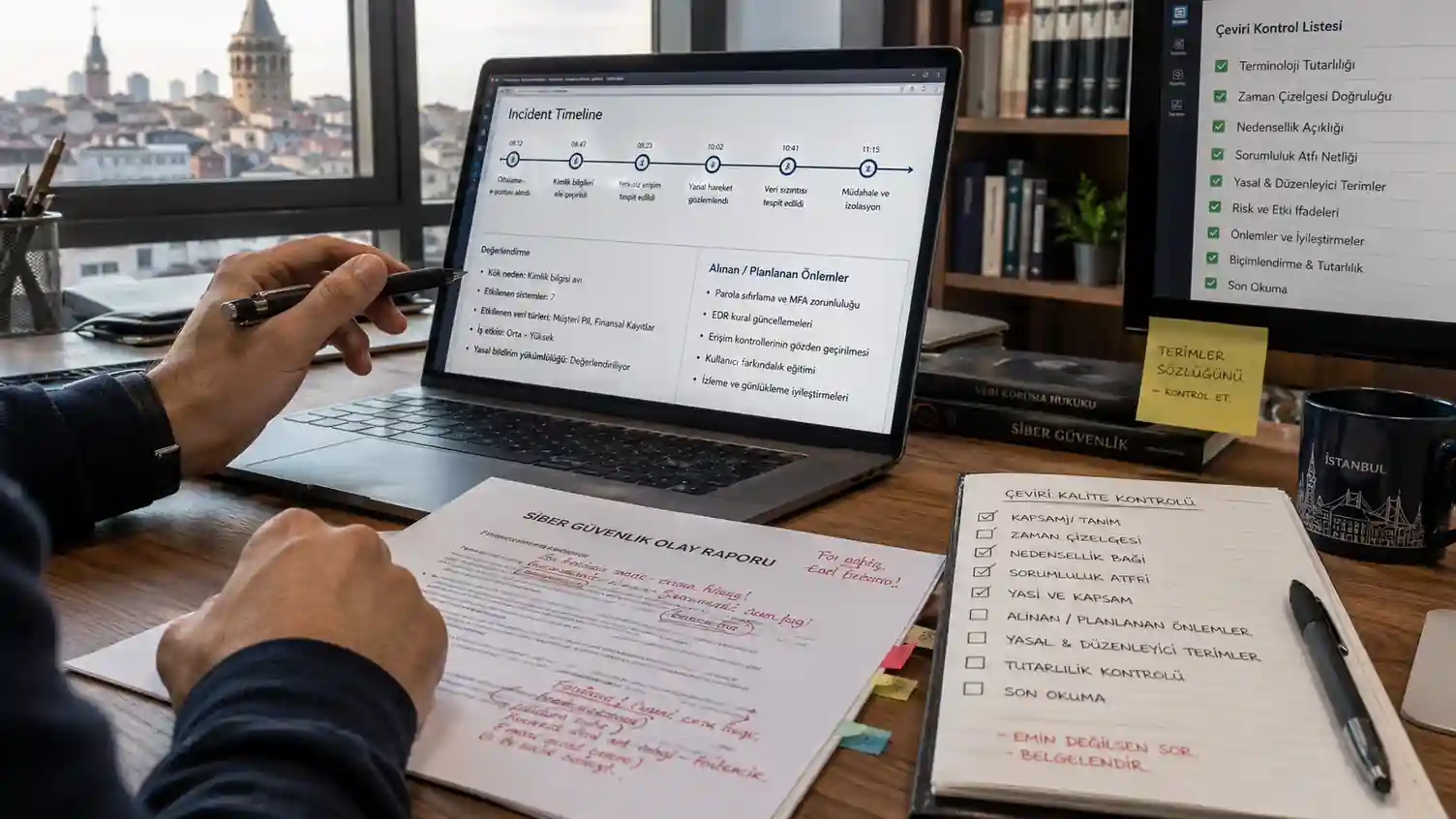
Your Incident Report Can Be Technically Correct and Legally Dangerous in Turkish.
The timeline, causation, responsibility, and mitigation language must survive translation without creating exposure.
Turkish Cybersecurity Incident Report Translation: Why Legal Risk Starts in the Timeline
The cybersecurity team writes the report after a breach. The facts are difficult but controlled. The timeline is careful.
Then the report is translated into Turkish for local stakeholders, regulators, or counsel.
The translation reads well. But the timeline shifts slightly. A mitigation action sounds completed when it was only initiated.
That is how a technically accurate report becomes risky — especially when it is handled as standard translation instead of part of a controlledTurkish localization workflow.
What Actually Breaks
Incident reports are not just technical documents. They are legal, evidentiary, and reputational records.
Translation errors often happen when teams rely on general delivery instead ofprofessional Turkish translation processes that protect meaning, uncertainty, and legal intent.
Turkish phrasing can unintentionally turn assumptions into facts, or actions into admissions.
Why Turkish Changes Legal Risk
Turkish often requires clearer subject–action relationships. That creates risk when the source intentionally keeps ambiguity.
“May have affected” cannot become “etkilemiştir.” “Appears to originate from” cannot become “kaynaklanmıştır.”
This is why incident reports must go through structuredquality assurance review, not just translation.
The Business Damage You Misread
Problems rarely appear immediately. They surface when legal counsel, regulators, or insurers compare versions.
Questions arise: Which version is authoritative? Did the company admit something unintentionally?
At that point, language becomes legal exposure — especially when sensitive information handling intersects withconfidentiality and security requirements.
What Proper Translation Does Instead
A strong workflow maps certainty levels, controls terminology, and preserves timeline logic exactly.
The Turkish version must behave like evidence — not interpretation.
What to Audit Before Release
Check causation verbs, certainty markers, and sequence logic. Ensure nothing implies resolution before it is confirmed.
Then compare all stakeholder-facing documents for consistency.
An incident report is not a place for linguistic interpretation.
The Turkish version must be precise, controlled, and defensible.
That is the standard for cybersecurity incident translation.
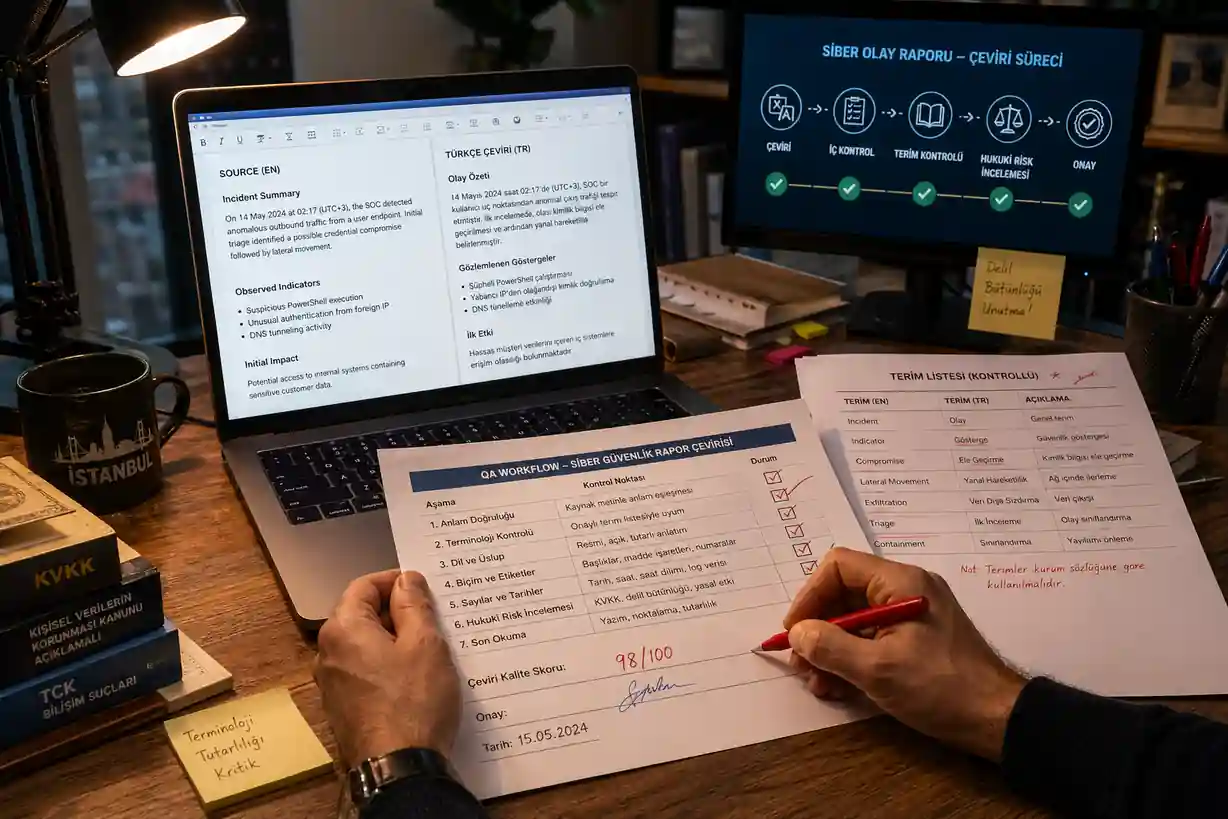
Process authority: review the language before customers, reviewers, or stakeholders expose the weakness.
FAQ
Why are cybersecurity incident reports risky to translate?
Because they combine forensic facts, legal exposure, technical systems, chronology, and mitigation claims. A small wording shift can change perceived responsibility or causation.
What sections need special care?
Incident timeline, attack vector, scope of exposure, containment actions, root cause, affected systems, notifications, and remediation language all need controlled Turkish wording.
Can translation affect legal defensibility?
Yes. If the Turkish version weakens chronology, overstates certainty, or changes responsibility language, it can create problems in legal, regulatory, or insurance review.
Protect the Incident Timeline Before It Becomes Evidence
We review Turkish cybersecurity incident reports for forensic clarity, legal defensibility, chronology, and terminology control.
Request Incident Report Translation Review