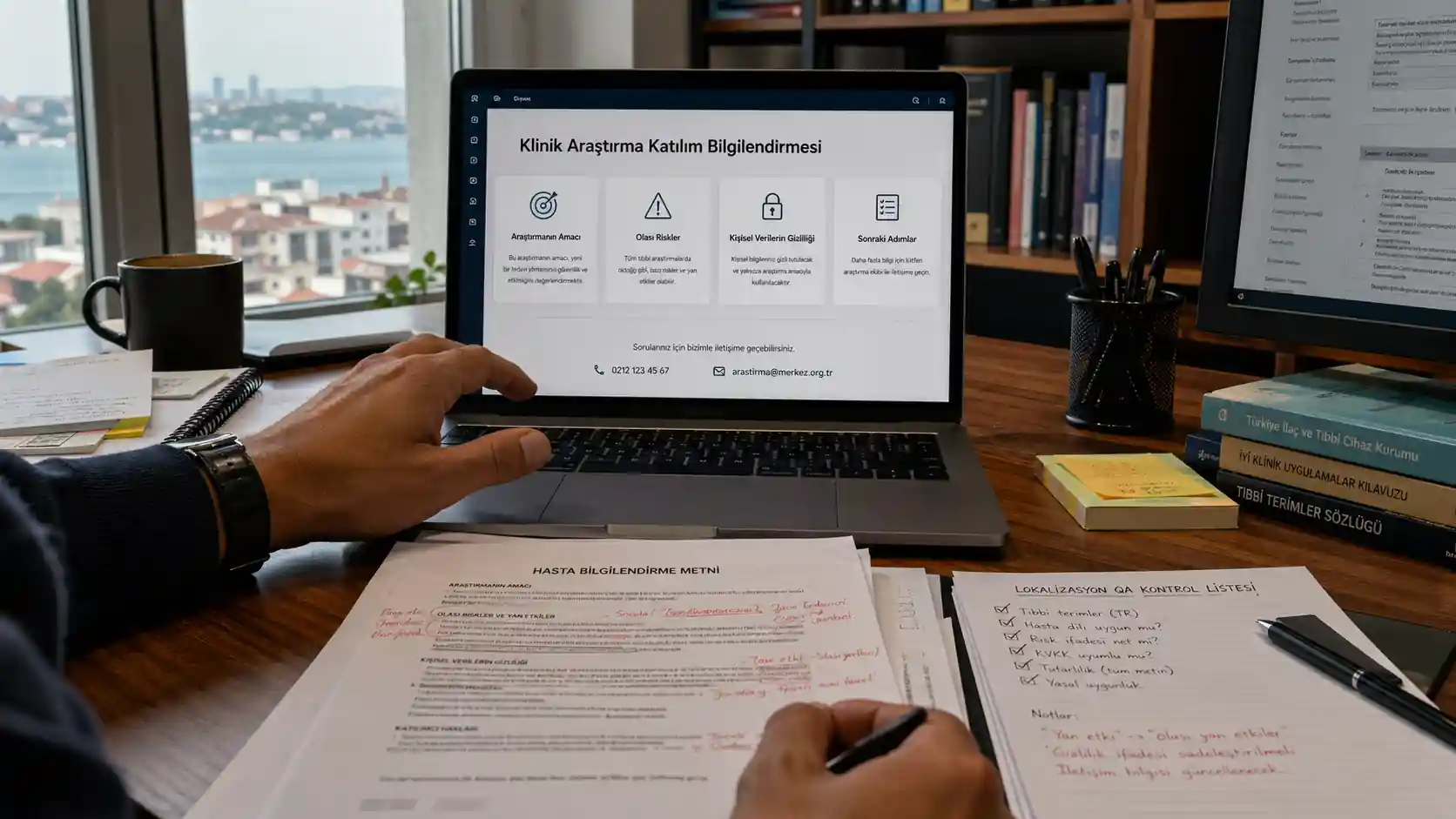
The Patient Did Not Refuse the Trial. They Refused the Uncertainty.
Recruitment content must explain participation, risk, privacy, and next steps in Turkish without sounding cold or coercive.
Turkish Clinical Trial Recruitment Content Localization: Why Patients Stop Before Consent
The campaign is live. The study is legitimate. The medical team is ready. The patient sees the Turkish recruitment page and starts reading.
Then they slow down.
The text explains eligibility, participation, privacy, and next steps. But something feels too technical, too promotional, or too institutional. The patient does not know whether they are being informed, persuaded, or enrolled.
They close the page before consent ever becomes relevant.
The recruitment funnel loses a candidate, but the real failure happened earlier: the Turkish language did not create enough trust to continue. This is why clinical recruitment content should be handled as part of a seriousTurkish localization workflow, not as ordinary campaign copy.
What Actually Breaks
Clinical trial recruitment content sits between marketing and medical communication. That makes it dangerous. If the Turkish version sounds too promotional, it can feel unethical. If it sounds too clinical, it can scare patients away. If it sounds too simple, it can weaken informed understanding.
Many teams translate recruitment content as if it were ordinary web copy. It is not. It must be accessible, medically responsible, legally careful, and emotionally calm. A normal content translation process is not enough when the reader is deciding whether to take the next step in a health-related study.
This is whereprofessional Turkish translationhas to protect meaning, tone, risk language, and patient comprehension at the same time.
A small tone error can change how patients perceive the entire study.
Why Turkish Changes the Patient Trust Problem
Turkish patient-facing health language needs careful balance. It should be respectful without becoming distant. Clear without becoming childish. Reassuring without minimizing risk.
Words around participation, eligibility, data privacy, compensation, screening, and voluntary withdrawal require special care. Turkish phrasing can easily sound like instruction instead of invitation, or like promise instead of explanation.
This matters because patient trust is fragile before consent. The person is still deciding whether the study deserves attention, and the language must support understanding without pushing the decision.
For life sciences teams entering Türkiye, this also connects directly to the local expectations aroundclinical trial and life sciences translation, where clarity, restraint, and terminology control are not optional.
The Business Damage You Usually Misread
Low recruitment performance may be blamed on targeting, channel mix, patient availability, or study burden. Those factors matter. But if Turkish recruitment language creates uncertainty, every channel performs worse.
The damage appears as low screening starts, incomplete forms, high bounce rates, weak response to SMS reminders, or patient questions that repeat information already present on the page.
That repetition is a signal. The content was present, but it was not trusted or understood.
It can also expose weaknesses in how sensitive patient information is described. Recruitment copy should never make privacy sound casual, vague, or secondary. It should align with the sameconfidentiality and security expectationsthat govern clinical communication and document handling.
What Proper Turkish Localization Does Instead
A proper workflow separates patient education, eligibility screening, privacy explanation, and consent-adjacent language. Each part needs different tone and precision.
The Turkish version should clearly explain what the study is, what participation may involve, what information is collected, whether participation is voluntary, and what happens after the patient submits interest.
It should avoid exaggerated benefit language. It should avoid cold institutional phrasing. It should make the next step feel informed, not pressured.
This is also why recruitment content should pass throughbilingual quality assurancebefore launch. The review should ask whether the Turkish copy is medically responsible, patient-readable, and consistent across every recruitment touchpoint.
What to Audit Before Launch
Review every patient-facing message as a decision point. Does the patient understand what is being asked? Does the text respect uncertainty? Does it avoid implying guaranteed benefit?
Check consistency across landing page, ads, SMS, email, screening forms, and call center scripts. If the language changes tone across channels, trust weakens.
Finally, test the Turkish version with a patient-comprehension mindset, not only a linguistic accuracy checklist. The question is not only whether the translation is correct. The question is whether a real patient can continue with informed confidence.
Patients rarely say, “The localization was weak.”
They simply do not continue.
Clinical recruitment content has to earn trust before consent, before screening, before a coordinator call.
In Turkish, that trust is built through clarity, restraint, and human language.
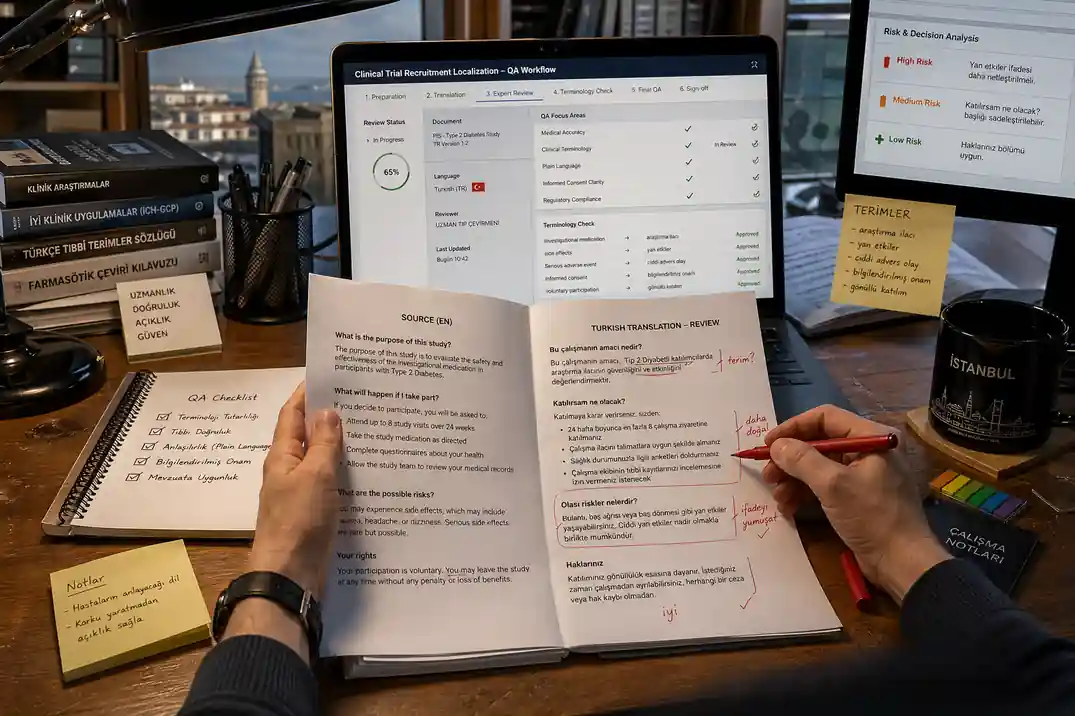
Process authority: review the message, terminology, and decision logic before the market exposes the weakness.
FAQ
Why is clinical trial recruitment content sensitive in Turkish?
Because patients must understand risk, privacy, participation, and voluntary choice. Literal translation can sound too technical, too promotional, or too intimidating, so clinical recruitment content needs careful Turkish localization rather than standard campaign translation.
Is recruitment localization the same as informed consent translation?
No. Recruitment content happens before formal consent. It must invite understanding without overstating benefit or minimizing risk. Informed consent language requires its own stricter clinical and legal review.
What should be reviewed before launch?
Patient-facing landing pages, ads, screening questions, email copy, SMS reminders, study explanations, privacy language, and next-step instructions should be checked together for tone, terminology, privacy clarity, and patient comprehension.
Make Turkish Patient Recruitment Clear Enough to Trust
We localize clinical recruitment content so Turkish patients understand the study, the process, and the decision before consent.
Request Clinical Content Review