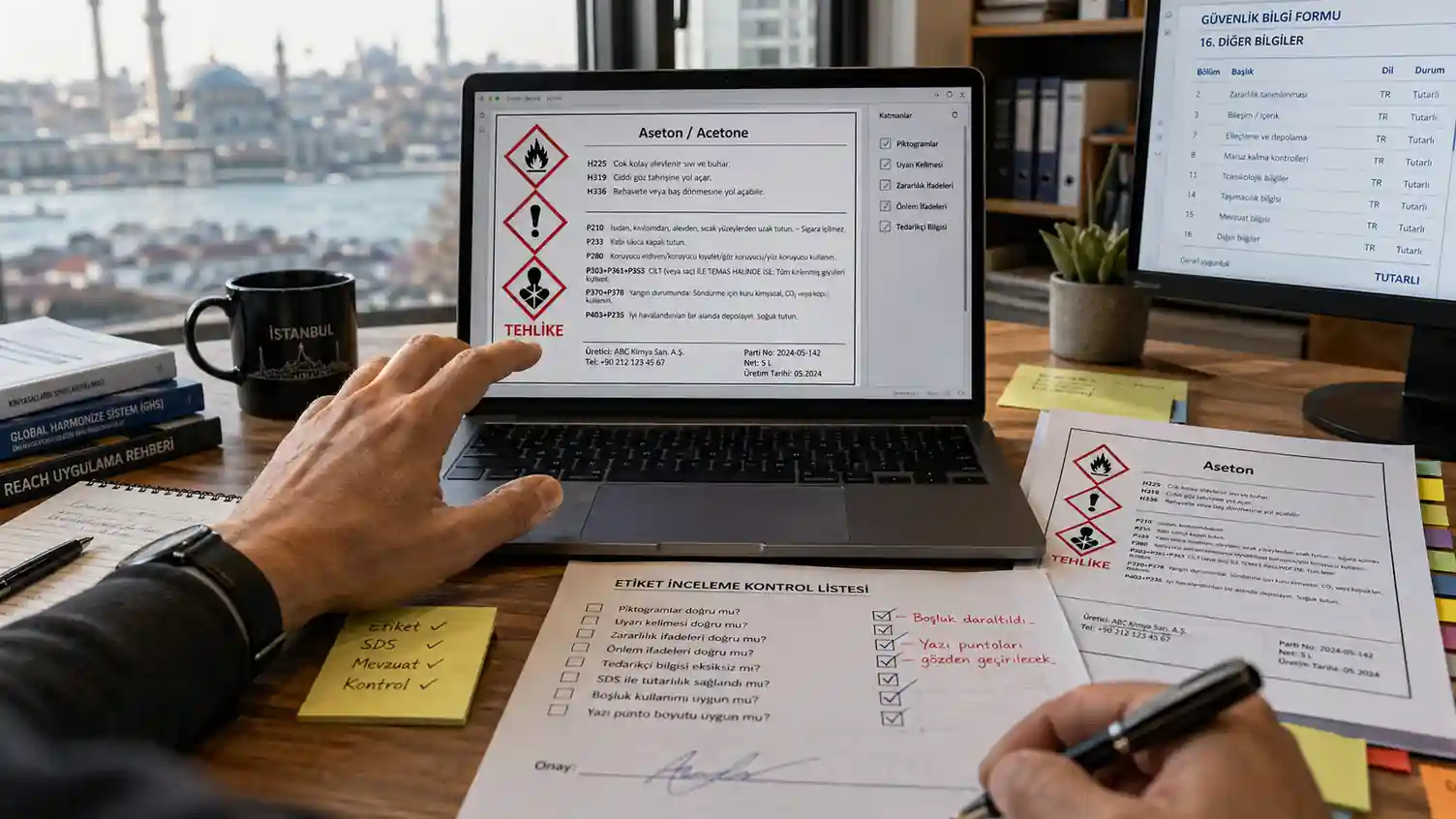
The Label Is Small. The Compliance Risk Is Not.
Chemical safety labels need Turkish hazard language, SDS consistency, and precise risk communication under space constraints.
Turkish Chemical Safety Label Translation: Why Compliance Risk Starts on the Smallest Surface
The product label is small. There is not much room. The team assumes the translation should be simple.
A hazard phrase is shortened. A precautionary statement is adjusted to fit. A term does not exactly match the SDS. The layout still looks clean.
Then the label reaches a distributor, inspector, warehouse worker, customer, or safety officer.
A phrase that should be precise now feels unclear. A warning does not match the safety data sheet. A precaution is less actionable than it should be.
The surface area is small. The compliance risk is not. That is why chemical labels should be handled as controlled technical and regulatory content, not as ordinary packaging copy.
What Actually Breaks
Chemical safety label translation fails when teams treat it as packaging copy. It is not packaging copy. It is regulated hazard communication under severe space constraints, and it belongs inside a specialist chemicals and safety translation workflow where terminology, SDS alignment, and user risk are reviewed together.
A Turkish label must preserve product identity, hazard category, signal word, hazard statement, precautionary statement, supplier details, and handling logic. It must also align with the SDS and any connected product documentation.
The most common failure is compression. To fit the label, wording gets shortened. Sometimes that is necessary. But if shortening changes hazard meaning, the label becomes unsafe.
A fluent short phrase is not automatically a compliant phrase.
Why Turkish Changes the Label Risk
Turkish can require more space to express the same safety relationship clearly. Shortening Turkish text too aggressively can remove the condition, action, or consequence.
Hazard and precautionary language cannot be improvised. A label should not use a different Turkish term from the SDS just because it fits better visually.
The challenge is to preserve controlled language while working within physical label constraints. That requires more than a general export-and-translate process; it requires professional Turkish translation by linguists who understand how technical meaning changes when space, layout, and compliance language collide.
A general translation workflow is not enough when the final words will sit next to symbols, hazard classes, batch details, supplier information, and emergency handling instructions.
The Business Damage You Usually Misread
Label errors may appear as distributor questions, inspection issues, relabeling costs, warehouse confusion, customer complaints, or SDS-label mismatch reviews.
The cost is not just correction. Once labels are printed or products are shipped, a small wording issue becomes a logistics, compliance, and reputation problem.
For companies entering Türkiye, label quality signals whether safety communication has been localized seriously. A weak Turkish label makes the product feel less controlled, especially when it sits beside technical documentation, SDS files, and distributor-facing compliance materials.
What Proper Turkish Chemical Label Translation Does Instead
A strong workflow begins with the SDS. The label should not be translated in isolation. Hazard terms, precautionary statements, and product identifiers must be checked against the Turkish SDS and terminology base.
Then the translator must balance space and safety. If a phrase must be shortened, the core action and hazard meaning must remain intact.
The review should include line breaks, readability, symbol relationship, typography, and the way a real user reads the label quickly. This is where bilingual quality assurance becomes practical risk control, not a final cosmetic check.
The final label must be clear in practical use, not only correct in a spreadsheet.
What to Audit Before Printing
Compare every hazard statement and precautionary statement against the SDS. Check signal words. Check product identifiers. Check supplier details. Check emergency information if present.
Review whether line breaks interrupt meaning. A bad break can make a warning harder to understand even if the words are correct.
Finally, test the label as a physical object. Can someone read it quickly? Does the Turkish warning tell them what to avoid and what to do? And if the material contains supplier data, formula references, internal documentation, or restricted product information, the translation process should also follow strict confidentiality and security protocols.
That is the real standard for safety label translation.
Chemical label translation is small-format, high-risk language.
It has to be concise without becoming vague.
It has to fit without weakening safety.
A strong Turkish label protects compliance, users, and the product before it ever reaches the shelf.
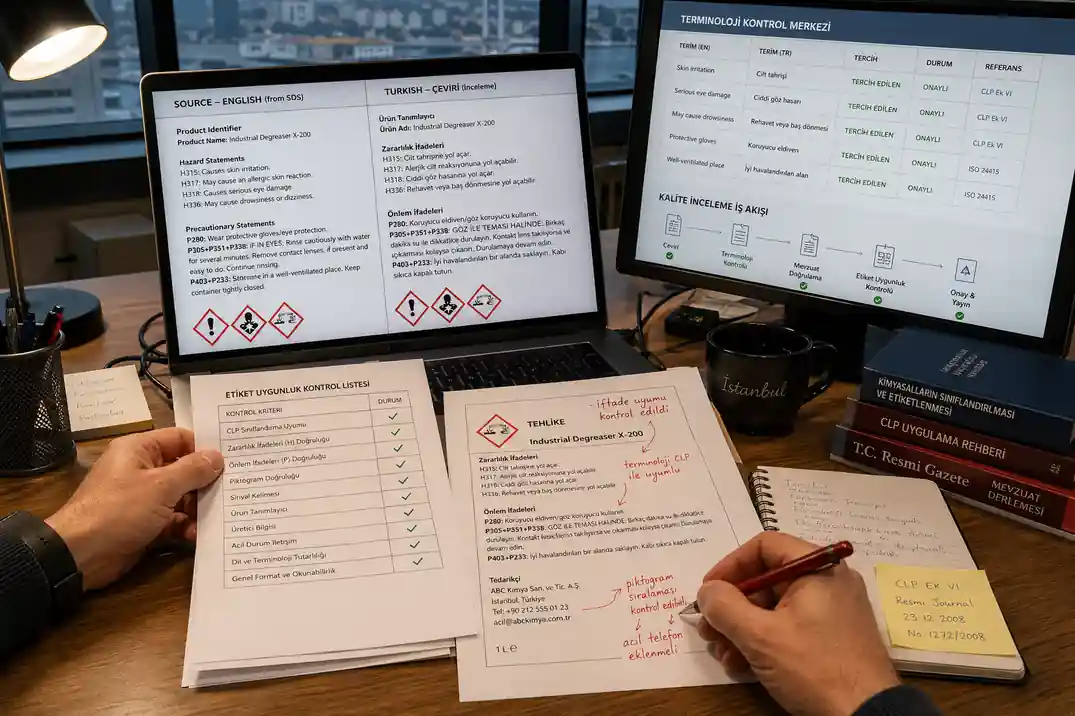
Process authority: review SDS alignment, hazard terminology, label readability, and space-constrained safety wording before printing.
FAQ
Why are chemical safety labels hard to translate?
Because they must preserve hazard meaning, legal terminology, pictogram logic, precautionary statements, and SDS consistency in very limited space.
Should labels match the SDS?
Yes. Hazard statements, precautionary statements, product identifiers, supplier details, and terminology must align with the Turkish SDS and related compliance materials.
Can a small label error create compliance risk?
Yes. A mistranslated hazard phrase, inconsistent signal word, or unclear precautionary instruction can create safety, regulatory, and liability exposure.
Check the Turkish Label Before It Reaches the Product
We review Turkish chemical safety labels for hazard terminology, SDS alignment, readability, space constraints, and compliance-sensitive wording.
Request Chemical Label Translation Review