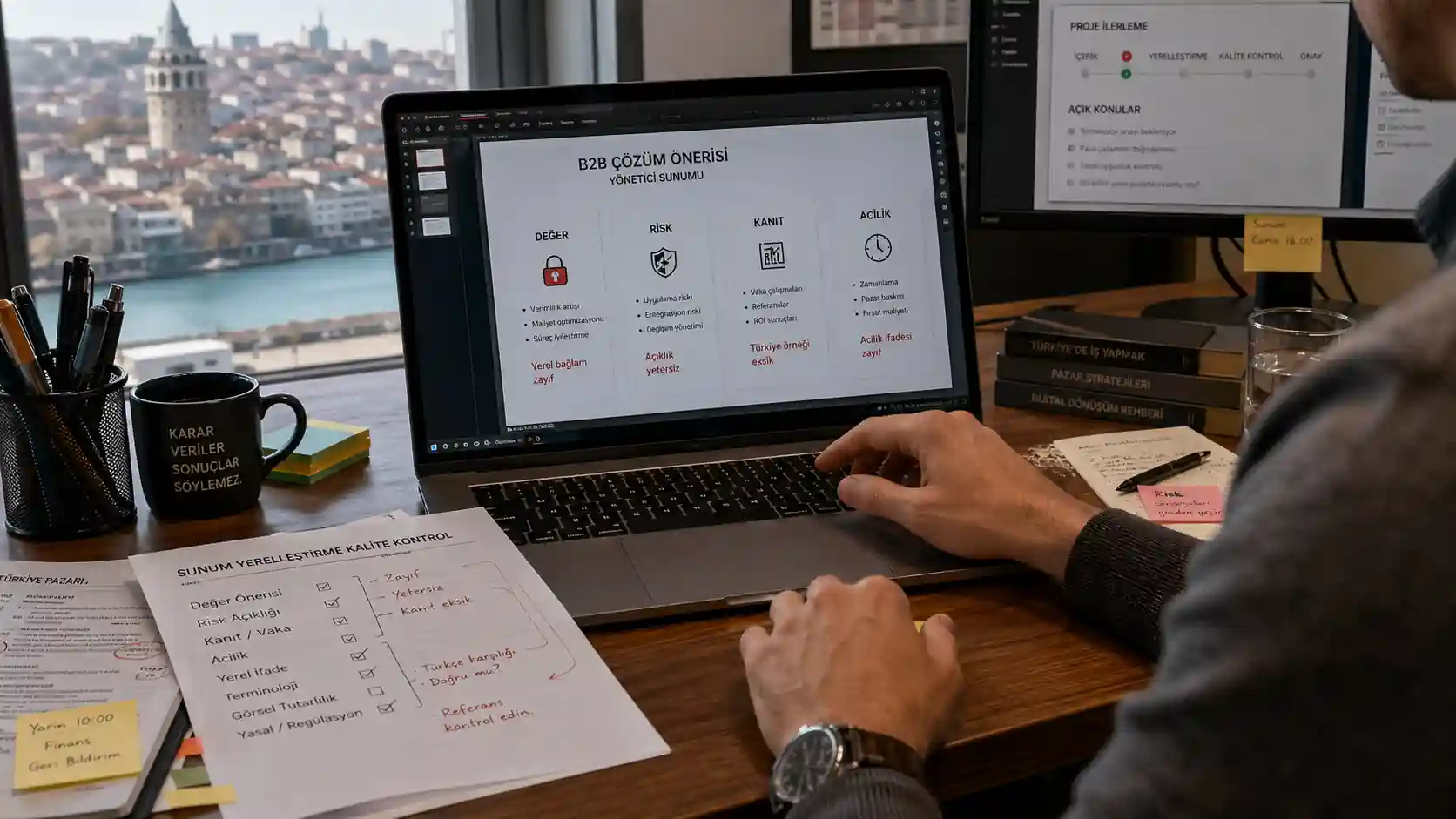
Your Deck Was Translated. The Business Case Was Not.
Turkish stakeholders stop believing a pitch when value, risk, proof, and urgency do not survive localization.
Turkish B2B Sales Deck Localization: Why Stakeholders Stop Believing the Pitch
The global sales deck works in English. It has the right product story, strong proof points, clean visuals, and a clear call to action.
Then it is translated into Turkish.
The slides still look good. The content is accurate. The brand voice seems intact.
But in the meeting, something changes. Turkish stakeholders listen politely. They ask practical questions. The energy drops.
The reason is simple: the words were translated, but the business case was not localized — which is a fundamental gap between translation and a realTurkish localization strategy.
What Actually Breaks
B2B sales decks are not information packets. They are decision tools. Each slide has a job: identify pain, create urgency, prove capability, reduce risk, and move the decision forward.
Direct translation preserves facts but weakens persuasion. This is where companies rely on standard translation output instead ofprofessional Turkish translation workflows that adapt meaning to decision-making context.
Headlines become flat. Proof points become descriptive. Pain becomes polite. Calls to action become vague.
The deck stops selling without looking broken.
Why Turkish Stakeholders Read Sales Language Differently
Turkish B2B buyers expect seriousness, clarity, and operational relevance. Over-polished slogans feel hollow. Casual phrasing reduces authority.
Claims must be supported quickly. Benefits must feel realistic. Risk must be addressed directly.
This is why localization must rebuild persuasion logic — and why it must be reviewed with the same rigor astranslation quality assurance processes.
The Business Damage You Usually Misread
Weak Turkish decks rarely kill deals instantly. They slow them down.
Sales cycles stretch. Internal champions struggle to explain value. Procurement reduces decisions to price. Technical stakeholders ask basic questions the deck should have already answered.
This is often misdiagnosed as market resistance. In reality, the localized deck did not provide stakeholders with the language needed to support the decision internally.
In enterprise environments, this also connects to how clearly risk, compliance, and handling of sensitive information are communicated — especially underconfidentiality and security frameworks.
What Proper Turkish Deck Localization Does Instead
A strong Turkish sales deck rebuilds the headline hierarchy. It keeps proof close to claims. It removes inflated language. It adapts objections and risks to the Turkish buying environment.
It also ensures terminology stays consistent across website, proposal, contract, onboarding documentation, and support communication.
If your messaging shifts across assets, stakeholders lose confidence.
What to Audit Before the Turkish Sales Meeting
Review every slide title. Does it create a reason to continue?
Review every proof point. Does it feel specific or generic?
Review every CTA. Does it define a clear next step?
Then test whether the Turkish version helps internal stakeholders explain the value to others.
A translated sales deck explains your product.
A localized Turkish sales deck helps sell it.
The difference is not wording. It is decision clarity.
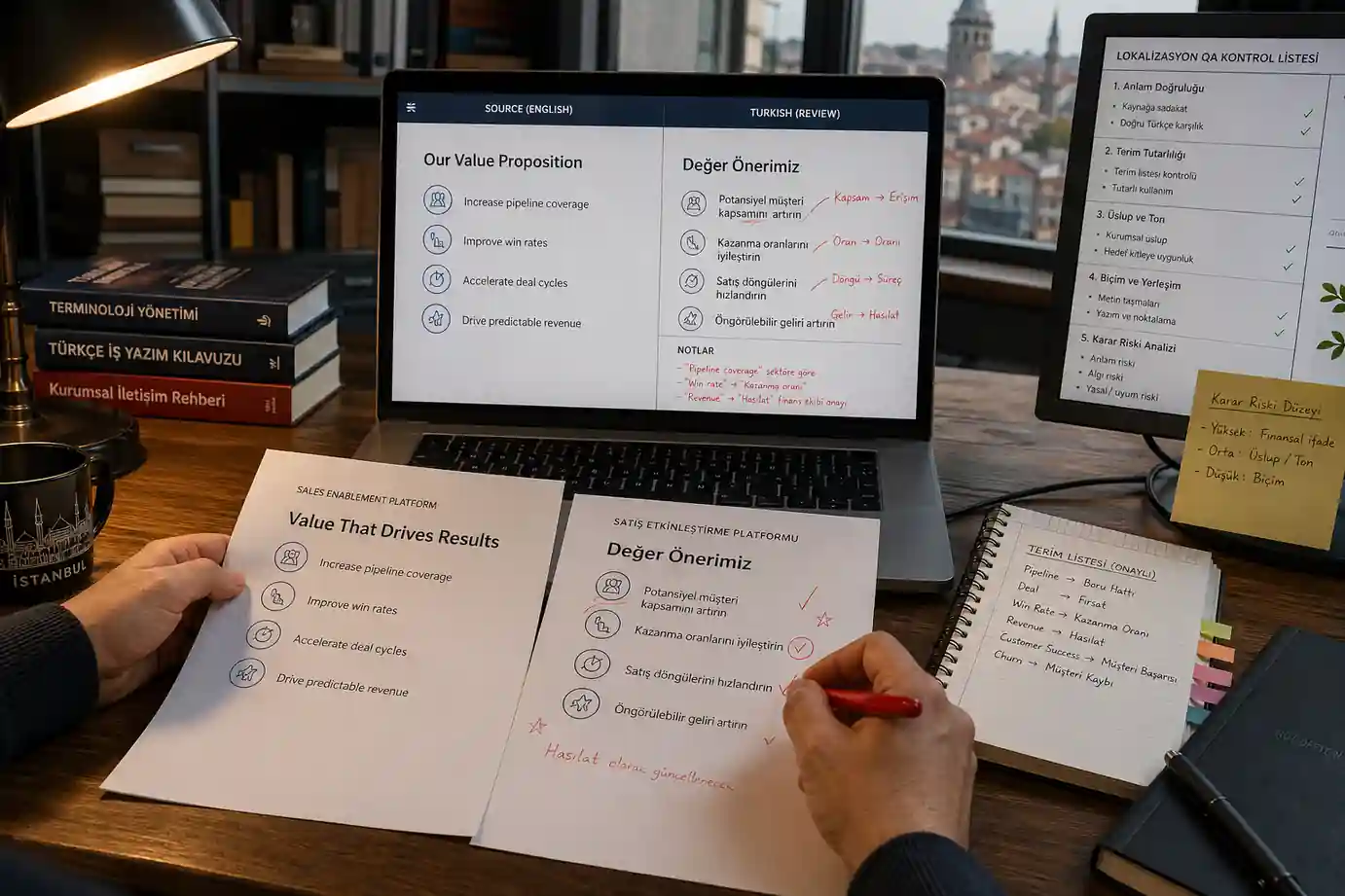
Process authority: review the message, terminology, and decision logic before the market exposes the weakness.
FAQ
Why do B2B sales decks need localization instead of translation?
Because a sales deck has to persuade, not simply inform. Value propositions, proof points, pain language, and urgency often need Turkish adaptation.
What usually fails in translated sales decks?
Headlines become generic, proof points lose force, risk language feels vague, and calls to action sound like marketing rather than business logic.
Can deck localization help sales teams in Türkiye?
Yes. A localized deck can make the buyer’s internal case easier by clarifying value, risk, implementation logic, and stakeholder relevance.
Turn Your Turkish Sales Deck Into a Decision Tool
We localize B2B sales decks so Turkish stakeholders understand the value, believe the proof, and see the cost of delay.
Request Sales Deck Localization Review