
The Deal Closed. The Turkish Customer Still Has to Believe the Product Will Work.
Customer onboarding documentation must reduce anxiety, explain value, and guide adoption in Turkish after the sale.
Turkish B2B Customer Onboarding Documentation Localization: Why Renewal Risk Starts After the Sale
The sale is done. Procurement approved. Legal signed. The customer is now officially yours.
Then the Turkish onboarding materials arrive.
The customer reads the setup guide and feels unsure. The admin instructions assume too much. The training deck sounds translated. The success plan does not clearly explain what the customer must do first.
That is how renewal risk starts after the sale — and it is directly tied to how yourTurkish localization strategy handles post-sale content.
What Actually Breaks
B2B teams invest heavily in pre-sale content and underinvest in onboarding documentation. But onboarding is where the customer discovers whether the promise becomes reality.
Direct translation often keeps instructions but loses guidance. This is a typical gap between basic translation delivery andprofessional Turkish translation workflows that align language with user behavior.
A setup guide may explain steps without sequence. A training module may describe features without showing relevance. A checklist may feel like workload instead of support.
Why Turkish Changes the Adoption Problem
Turkish onboarding content needs explicit structure. Users expect clarity on sequence, responsibility, and outcomes — especially in multi-stakeholder environments.
Tone matters. If documentation sounds translated, confidence drops. If terminology is inconsistent, trust weakens.
This is why onboarding documentation must be reviewed with the same rigor astranslation quality assurance processes, not treated as operational text.
The Business Damage You Misread
Poor onboarding appears as slow implementation, repeated support tickets, missed adoption milestones, and delayed value realization.
Teams blame customer commitment or product complexity. But often, the issue is that onboarding documentation does not make success feel achievable.
This becomes critical in enterprise environments where data handling, workflows, and internal communication must align withstrict confidentiality and security expectations.
What Proper Turkish Onboarding Localization Does
A strong onboarding system maps the entire customer journey: kickoff, setup, training, activation, reporting, and value tracking.
Each stage requires different Turkish communication logic — not just translated text.
Terminology must align across product UI, onboarding materials, contracts, and support communication. Otherwise, the customer experiences fragmentation.
What to Audit Before Rollout
Review onboarding content from a first-week perspective. Does it reduce uncertainty or create friction?
Identify ownership clearly: admin, end user, IT, finance, or customer success.
Then test whether the Turkish version helps internal stakeholders explain adoption to others. If not, the documentation is not doing its job.
A customer does not renew because documentation exists.
They renew because the product becomes usable inside their organization.
Turkish onboarding documentation is not translation output. It is adoption infrastructure.
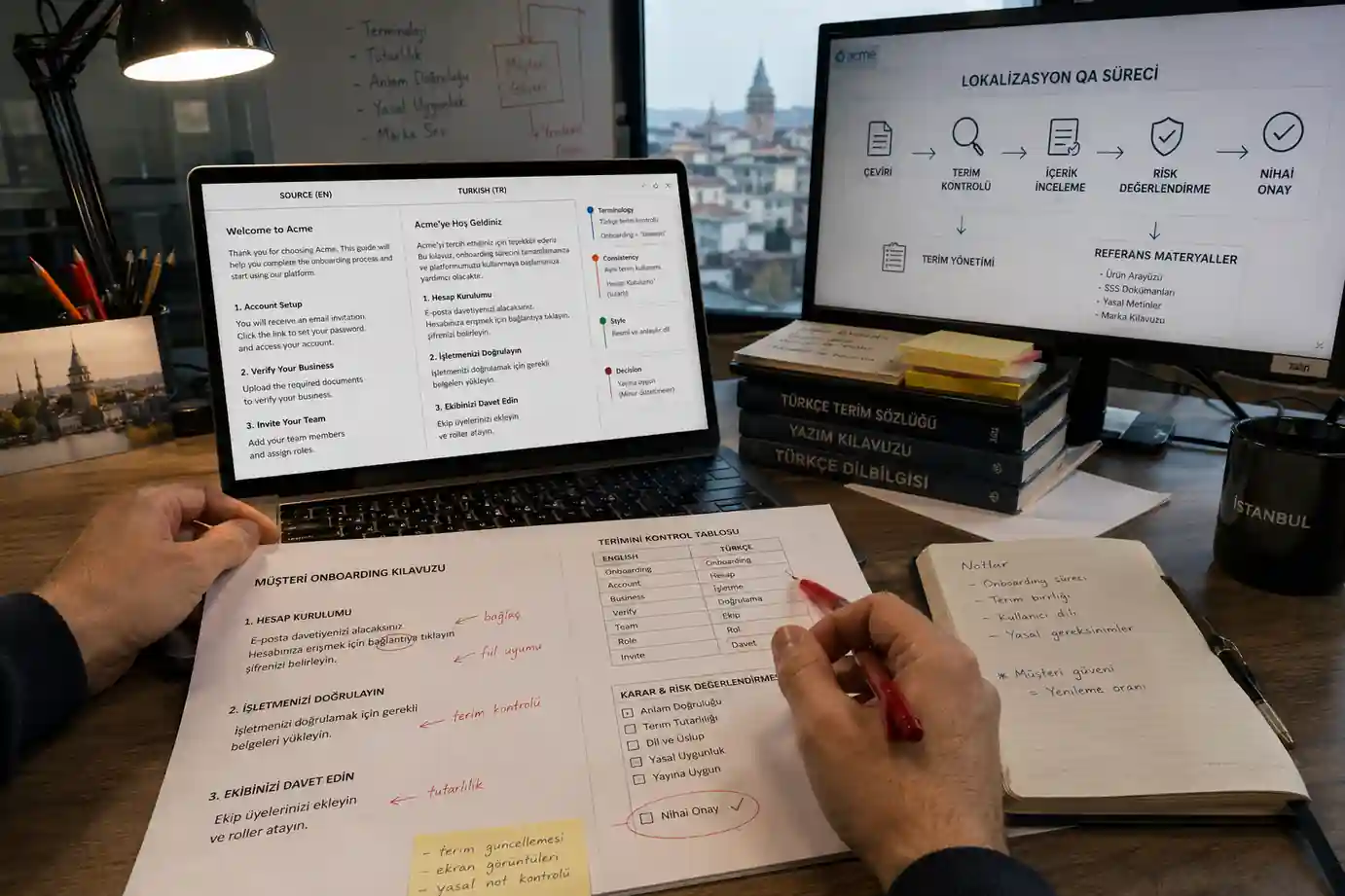
Process authority: review terminology, tone, and risk logic before the market exposes the weakness.
FAQ
Why does onboarding documentation affect renewal?
Because poor onboarding slows adoption, increases support dependency, and prevents customers from seeing value early.
What should be localized?
Implementation guides, kickoff decks, admin setup docs, user training, help center articles, email sequences, success plans, and adoption checklists.
Is onboarding localization different from product localization?
Yes. Product localization handles interface use. Onboarding localization explains how the customer should adopt the product successfully inside their organization.
Turn Turkish Onboarding Content Into Renewal Protection
We localize B2B onboarding documentation so Turkish customers understand setup, adoption, value realization, and next steps without friction.
Request Onboarding Documentation Review